
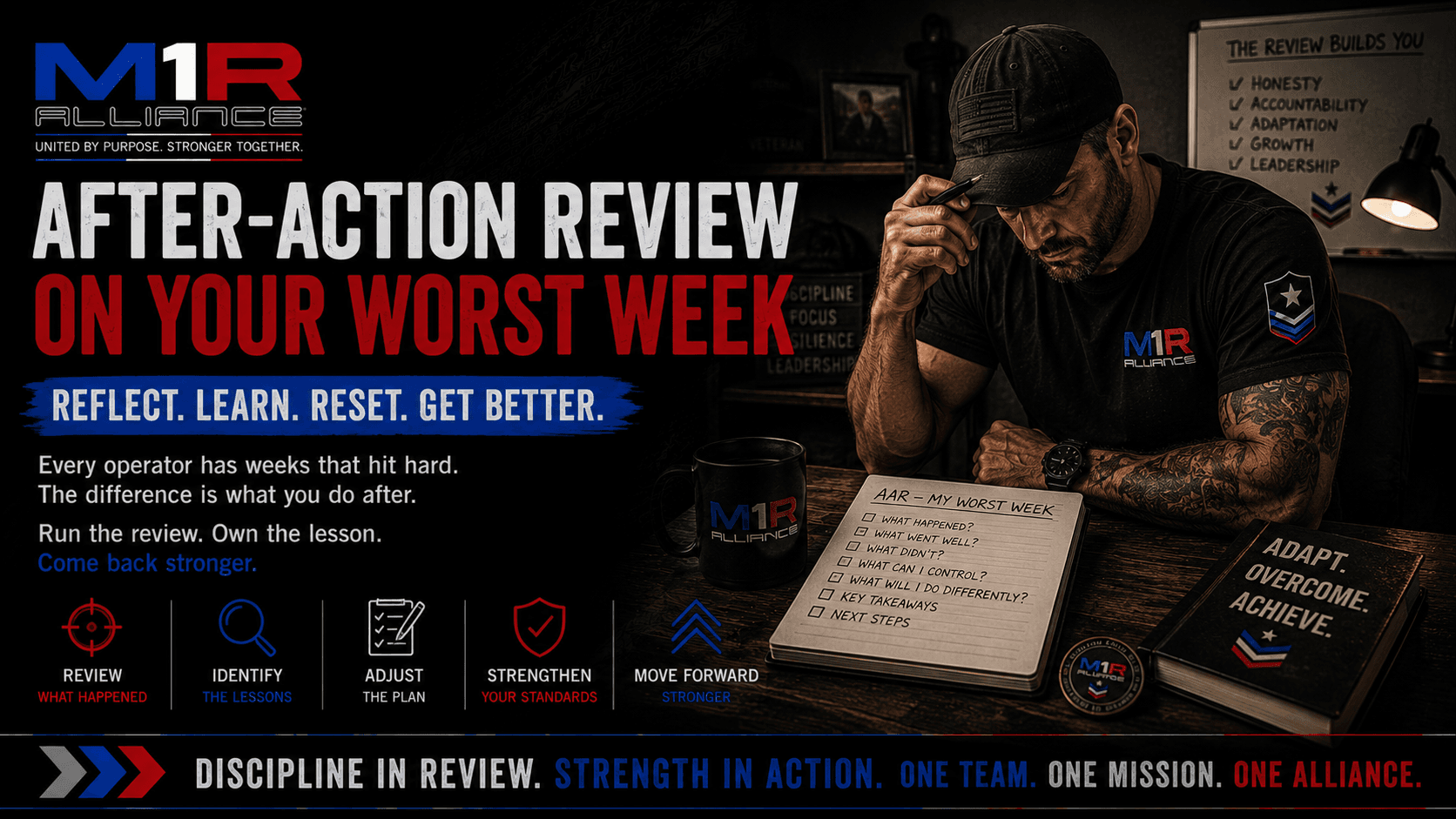
You already own one of the most powerful self-improvement tools going, and you probably stopped using it the day you left the job. The after-action review — the debrief, the hot wash, whatever your mob called it — is a discipline most people in civilian life have never even heard of. You ran them after every serious job. Then you got out, and you quietly stopped reviewing anything at all.
Here's the move: take that exact discipline and point it at your ordinary life. Not at trauma — we'll come back to that — but at a normal bad week. Because a bad week reviewed properly becomes a lesson. A bad week left unreviewed just becomes next week.
The tool you already know
Strip the AAR back to its bones and it's four questions:
- What was supposed to happen?
- What actually happened?
- What worked, and why?
- What do we change next time?
No blame, no ego, no spin. Just an honest comparison of intent versus reality, and a decision about what to do differently. It works on a task force and it works on a Tuesday. The genius of it is that it turns experience — which most people just accumulate — into actual learning.
Experience isn't what happens to you. It's what you take from what happens to you. The AAR is how you take it.
An important line: this is not a trauma debrief
Let's be crystal clear, because it matters. This is a review of your decisions, your habits and your performance across an ordinary week. It is not sitting down to re-live a traumatic incident, and it is not a tool for processing the heavy stuff you're carrying.
Digging into trauma on your own, unstructured, can do more harm than good — that's work for a professional who knows how to hold it safely. If a review starts pulling you toward a specific bad job or a dark place, that's your signal to close the notebook and, if you need it, talk to a psych or reach out for support. Keep this habit firmly in the lane of "how did I run my week," not "let me re-open a wound."
How to run your weekly AAR
Set aside twenty minutes, once a week. Sunday evening works for a lot of people — close out the week that was, set up the week ahead. Grab a notebook, not a screen. Then walk the questions.
What was supposed to happen?
Cast back to the start of the week. What did you intend? The training you'd planned, the work you meant to get through, the promise you made to your partner, the habits you said you'd hold. Get honest about what "good" was actually supposed to look like.
What actually happened?
No spin, no excuses, no beating yourself up either — just the facts. You planned four sessions and did one. You said you'd knock off on time and worked late every night. You meant to be patient with the kids and lost it on Wednesday. Lay it out flat. You can't fix what you won't look at straight.
What worked, and why?
This is the half everyone skips, and it's the more important one. What went well? What are you proud of? When you did hold the standard, what made it possible — did you prep the night before, get to bed early, ask for help? Find the conditions that produced your wins so you can build more of them. We're wired to hunt for faults; make yourself hunt for what worked too.
What do I change next time?
Here's the rule that makes this stick: pick one thing. Not ten. One change, small and specific, that you'll action next week. "Be better" is useless. "Pack my gym bag the night before so I actually train" is a plan. One real change a week is fifty changes a year, and that compounds into a different life.
The bloke who reviews one thing a week and actually changes it will run rings around the bloke with the perfect ten-point plan he never starts.
Why this beats "trying harder"
Most people respond to a bad week by vowing to try harder, then feeling like a failure when willpower runs out by Wednesday. The AAR is different because it doesn't rely on willpower — it relies on systems. When you find out that your training falls apart because you decide on the day, the fix isn't more discipline, it's packing the bag the night before. You're debugging the system, not flogging yourself.
It also builds something quietly valuable: self-awareness without self-flagellation. You learn to look at your own performance the way a good leader looks at a team's — clear-eyed, interested in improvement, not interested in blame. That's a skill, and it's rarer than you'd think.
Make it a rhythm
The power is in the repetition. One AAR is interesting. Fifty in a row is transformation. To keep it going:
- Same time, same place. Anchor it to something you already do so it doesn't rely on memory or motivation.
- Keep it short. Twenty minutes, four questions, one action. If it becomes a two-hour ordeal you'll quit. Lean and repeatable beats thorough and abandoned.
- Track the one thing. Write down the change you're actioning and check next week whether you did it. That loop is where the growth lives.
- Include the wins. Especially in the flat weeks. Finding one thing that worked keeps it from becoming a misery session.
A worked example
Let's make it concrete, because the four questions are easy to nod along to and harder to actually run. Say you had a rough week. Here's what an honest AAR of it might look like.
What was supposed to happen? You'd planned four training sessions, to knock off work by six most nights, and to be patient with the kids after a stressful stretch.
What actually happened? You trained once. You worked late four nights out of five. And you lost your temper at the kids on Wednesday over something small. No spin, no excuses — just the facts laid flat.
What worked, and why? The one session you did do was Monday morning, before the day could get its hooks in — because you'd packed your bag the night before. And the one night you got home on time, you'd blocked the calendar and told people you were leaving. So the wins weren't luck. They came from specific things you set up in advance.
What do I change next? One thing. Pack the gym bag every night, so the morning session has no friction. That's it. Not "train more" — one concrete lever you'll actually pull.
Run through it and you can see the magic: the bad week stops being a vague cloud of failure and becomes a couple of clear, fixable system problems. You're not a slob who can't train — you just decide on the day, so fix the deciding. That's the whole game.
Ditch the blame spiral
The single thing that ruins a self-review is turning it into a flogging. If your AAR becomes a list of everything wrong with you, you'll dread it and quit within a fortnight, and you'll learn nothing useful — because shame narrows your thinking instead of sharpening it.
Run it the way a good leader runs a team debrief: clear-eyed, honest, focused on improving the system rather than punishing the person. You made some poor calls this week? Fine — everyone does. What's the lesson, what's the one change, and what did you actually do well that's worth repeating? Curiosity fixes things. Self-hatred just makes you avoid looking. Keep it firm but fair, the way you'd want a good boss to run it on you.
Why this beats a bigger to-do list
You might wonder why bother with a review when you could just write a longer to-do list. Here's the difference. A to-do list tells you what to do next. It never tells you why last week fell apart, so you make the same mistakes on repeat, just with a longer list to feel guilty about. The review is what turns experience into a lesson instead of a groundhog day.
It's also how you catch the slow drift before it becomes a problem. Small things — sleep slipping, training tapering off, letting the little promises to yourself go — don't set off alarms on their own. But run a weekly review and you spot the trend early, while it's still a one-line fix, instead of three months later when it's quietly become your whole life. Ten minutes of honest looking beats a year of wondering why nothing's changing.
Bring it to your people
You can run this solo, but it's even better shared. A mate, a partner, a small crew who each run their own and compare notes. It brings back a bit of that shared standard-setting we lose when we leave the job — the mutual accountability that made us better than we'd have been alone. If you've been missing that, this is a simple way to get some of it back.
You spent years using this discipline in service of the mission. Turn it on your own life now. Review the week, keep what worked, change one thing, and go again. That's how good operators got good in the first place — and it's how you keep getting better long after the uniform's hung up. Backing our own includes backing the standard you hold yourself to.