
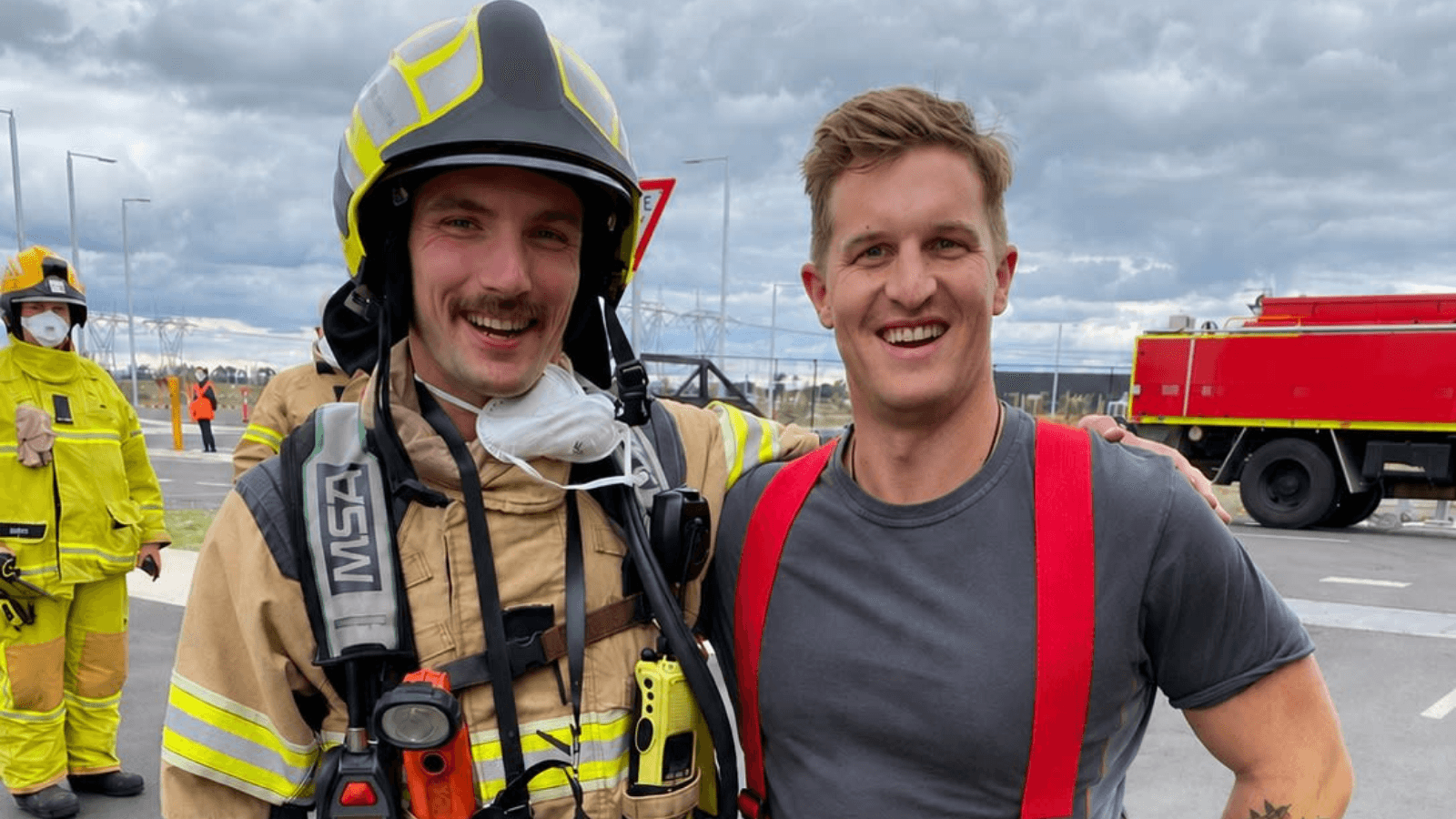
A mate told him to put it on TikTok. The first couple of videos went gangbusters, and Rick — a serving Melbourne firefighter who'd been quietly helping coppers, fireys and ambos through the bad weeks for the better part of a decade — suddenly had a small mountain of DMs from strangers asking the same kinds of questions his mates had been asking him for years. That was the moment he realised what he'd been treating as a side-of-the-mouth favour was actually a gap big enough to build a business inside.
The firie behind it
Rick has been with Fire Rescue Victoria for ten years. He started full-time with CFA, then moved across when fire service reform merged the full-time CFA component with the Metropolitan Fire Brigade to form FRV — Victoria's statewide paid professional fire service. He still rotates between the truck and the psych department, hopping in and out of secondments as a wellbeing officer. The wellbeing officer role is the evolution of what used to be the agency chaplain — same idea, religious component stripped off, still the person who turns up at the station when someone needs to talk and at the hospital when someone's family does.
The other thing Rick has done for years, without a title or a website, is be the person his mates phone after a bad shift. Code One Support is that — formalised.
How it started
The honest version is that Rick didn't set out to start a business. He set out to post a few videos because a mate kept telling him to. What came back made him pay attention.
"There's a, I guess, a need here," he said about the early TikTok response. The more he looked into it — not just on his own anecdotal read, but checking what the data actually said about first responder mental health in Australia — the more obvious it became that the gap wasn't a feeling. It was the shape of the system. Plenty of services have Employee Assistance Programs. Most members don't use them. A recent VicPol survey Rick references put it at roughly 60% of respondents seeking mental health support outside their own service, and that's among the people who actually filled in the survey — a self-selecting slice.
There are reasons. Some of them are practical: members don't want disclosures sitting on the agency record where they might affect a firearms authority or a promotion. Some of them are cultural: a career inside a uniform builds a deep reflex for who's "one of us" and who isn't, and corporate wellness arrives wearing the wrong colour. "As soon as we sniff corporate," Rick said about the agency mental-health offerings, "we don't trust them. You can sit and talk to us about what it's like to give CPR to a kid, but you've never done it. So you'll never understand."
Code One Support is built around that. It's mental health support designed and delivered by someone who has been on the same trucks the people he's helping are still climbing onto.
What he actually does
Most of Rick's work happens in person, on station floors. He runs forty-five-minute mental health workshops at CFA brigades and FRV stations across Victoria, has been invited out to the airport to sit down with the Aviation Rescue and Fire Fighting crew, and is currently in conversation with Queensland Police about doing workshops with their members. The format is informal by design — plain language, real examples, no slides full of HR jargon.
The most consistent topic is decompression. Specifically, the transition between the truck and the dinner table. A career firefighter or paramedic might attend a fatal road crash at four in the afternoon and be home with their kids by six, and there is no formal training anywhere in any service for that ninety-minute turn-around. Most people work it out themselves, and a lot of them get it wrong for years before they realise. Rick's workshops are about handing over the tools nobody handed out at recruits.
Alongside the workshops, Rick has just launched Code One Debrief — a workbook, available as a PDF or a printable, that walks a first responder through a seven-step self-debrief after a critical incident. The structure is deliberate: take what's in your head, put it on a bit of paper, and finish with a self-assessment checklist that routes you to professional help if the answers say you should go. It's not designed to replace a session with a psych. It's designed for everywhere the formal system doesn't reach — the volunteer brigade an hour out of town with no welfare officer, the station sergeant who doesn't know how to start the conversation, the member who got back to the truck after the worst job of their career and got nothing.
What he's learned that's worth knowing
Two things come up again and again when Rick talks about the work.
The first is that the peer-vs-corporate distinction isn't a preference. It's the whole load-bearing wall. The Employee Assistance Programs and the agency-run wellness initiatives aren't bad, but for a huge chunk of the workforce they sit behind a trust barrier that doesn't move. Rick has watched twenty firefighters in a room put their hands up to say they'd sought mental health support, then watched all twenty hands go back down when the psychologist asked whether they'd used the agency channel. The fix isn't more services. The fix is more services that look and sound like the people they're for.
The second is simpler and harder to say out loud. "I think a lot of us just want to be heard," Rick said about what most of the people who phone him are actually looking for. Not solutions. Not a framework. Not a list of breathing exercises pulled off Google. Someone who has been in the same truck, on the same job, who can sit in the silence afterwards without trying to make it tidy.
Code One Support is the business shape of that.
What's next
The Code One Debrief workbook is now live — the first tangible product attached to the business, sitting alongside the calendar of workshops. Workshop demand has already outpaced what a one-person operation can deliver alongside a full-time job at FRV, so the next year will be partly about deciding what to hand off and what to keep doing personally. The Queensland Police conversation, if it lands, will be the first interstate engagement. There's also early discussion about turning the Debrief workbook into a mobile app so it lives in a member's pocket rather than in a PDF on their desktop — accessibility, Rick said, is the single biggest factor in whether a tool actually gets used at three in the morning.
Where to find Rick and Code One Support
Code One Support lives at codeonesupport.com, with the new Code One Debrief workbook available there directly. TODO: confirm and add Rick's TikTok and Instagram handles, and the M1R Alliance directory listing slug once the listing goes live.
If you serve or have served in any Australian emergency service and you run a business, M1R Alliance lists you free for life. Apply via the free first responder listing or the free veteran listing. If your business sits in the wellbeing space like Code One Support does, you'll also find the rest of the community already on the directory at paramedic-owned businesses, firefighter-owned businesses and the full first responder owned directory.
Frequently asked questions
Do I need to be in Victoria to access Code One Support's workshops?
Most of Rick's workshops to date have been with Victorian agencies because that's where he serves and where his existing network sits. Code One Support is actively expanding interstate — conversations with Queensland Police are underway at time of writing, and the forthcoming Code One Debrief workbook is designed to work for first responders anywhere in Australia. Reach out via the Code One Support channels and they'll tell you what's possible in your state.
Is this only for fireys?
No. The work is built around the things first responder roles have in common — shift rhythm, exposure to critical incidents, the trust gap with internal services, the trip home after a bad job — and applies across police, fire (career and volunteer), ambulance and paramedic, SES and corrections. Workshop content is tailored to the audience in the room.
What is the Code One Debrief workbook for?
It's a self-debrief tool for the moments where the formal system doesn't reach you. After a critical incident, an accumulation of shifts, or a single job that wouldn't leave you alone — the workbook walks you through a seven-step process that gets the contents of your head down on paper and ends with a self-assessment of whether you should be calling someone. It's twenty-seven dollars, available as a digital PDF or a printable, and you can grab it at codeonesupport.com/debrief. It's not a substitute for professional mental health support; it's a bridge to it.
I'm not in a great place right now. Who do I call?
For veterans and current serving ADF members: Open Arms, the 24/7 Veterans and Families Counselling Service, on 1800 011 046. For anyone in crisis: Lifeline on 13 11 14. For broader mental health support: Beyond Blue on 1300 22 4636. None of them charge. Both Open Arms and Lifeline are confidential and twenty-four hours a day.