
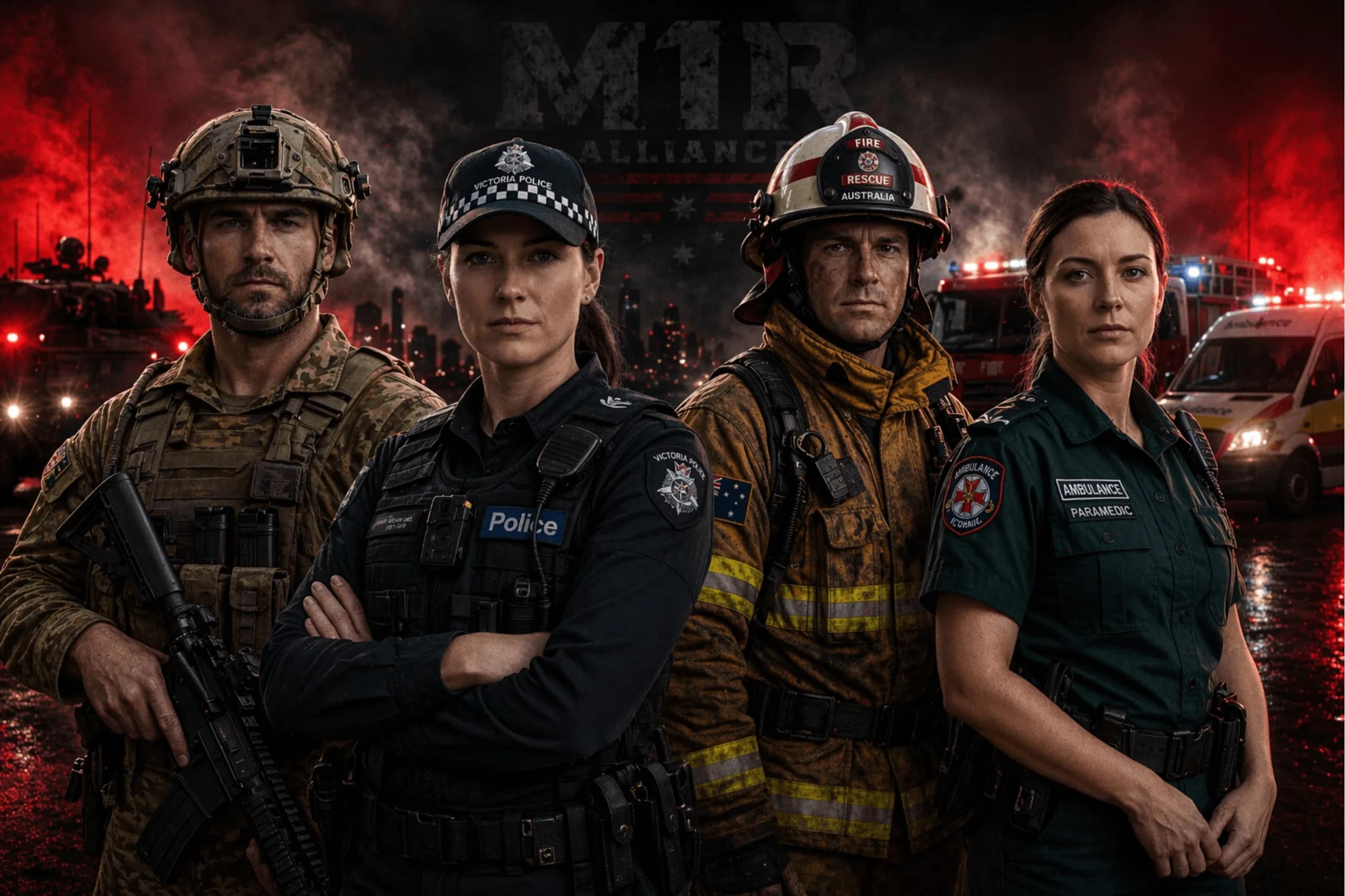
Starting a business after the uniform.
A practical guide for Australian ADF veterans and current and former first responders who are thinking about — or already starting — a business of their own. Transition timing, legal basics, the grants and support that exist, mental health resources you should know about, and what the directory looks like once you’re trading.
Most transition help is about jobs. This is about owning the work.
The transition support available to people leaving the ADF or stepping out of a first responder career is genuinely good in places — career coaching, resume help, mental health hotlines, the ADF Transition Centre, agency welfare branches. Almost all of it is built around the assumption that what you want next is a job. The people who want to start a business get less attention by default, and they tend to find each other by accident rather than by design.
This guide is for the people who want to own the work. The veterans running a building company in Townsville, the ex-cop training corporate security teams in Sydney, the retired firefighter running a cafe in country Victoria, the paramedic taking weekend clients for first-aid courses while still on the road. It won’t tell you how to write a business plan — there are thousands of those — but it will tell you the specific things that matter when you’re doing this with the uniform behind you.
When do you actually start?
The three windows people normally start a business around transition are before (side-business while serving), at separation (use the transition payment and the time off as runway), and after (a year or two into civilian life, once the dust has settled and you know what you actually want). Each has real trade-offs and almost nobody tells you about the differences in advance.
Starting before separation is the lowest-risk path. Income is steady, your trade or skill is still current, and you can test the business slowly without the pressure of replacing your pay. The downsides are time and energy — shift work plus running a business is a real grind — and the service-specific rules about secondary employment, which vary by branch and rank. Talk to your chain of command early; it is almost always allowed with the right disclosure.
Starting at separation is the most romantic option and the most common mistake. The ADF transition payment plus accumulated leave can look like enough runway, but a year disappears faster than you think when you’re also processing leaving the uniform behind. If you do go this route, have your ABN registered, your business plan roughed out, and at least one paying client lined up before your last day in service. Treat the transition payment as time, not capital.
Starting after a year or two in civilian work is underrated. You arrive at the business decision with a clearer head, you’ve seen the civilian market from the inside, and you usually have a network. The downside is that the longer you delay, the more comfortable the salary becomes — many people who plan to start a business eventually never do. Set yourself a hard date.
First responders typically transition over a longer arc than ADF veterans — retirement after 20–30 years of service is more common than mid-career separation. The same windows apply, but the "before" period is often a decade rather than a few years.
The boring stuff that actually matters
You need an ABN (Australian Business Number) before you can invoice anyone or charge GST. It’s free and you apply through the Australian Business Register at abr.gov.au. The application asks about your structure, your industry, and your projected turnover. Allow about thirty minutes; most applications are approved instantly.
Structure: most new businesses start as a sole trader because it’s the simplest and cheapest structure to run. Income flows through your individual tax return, the ABN is in your own name, and your accounting is straightforward enough that you can run it from a spreadsheet in the early days. The downside is that you and the business are legally the same entity — if the business is sued, your personal assets are exposed.
A Pty Ltd (proprietary limited) company is a separate legal entity. It costs more to set up (~$500 with ASIC, plus an accountant) and a few hundred dollars a year to maintain, but it protects your personal assets and looks more credible to corporate or government clients. If you’re going to work with major employers, sub-contract on defence projects, or take on real liability, the Pty Ltd is the right call earlier rather than later.
GST kicks in once your annual turnover crosses $75,000 (or $150,000 for non-profits). You can register voluntarily below that threshold and claim GST credits on business purchases, which sometimes makes sense in capital-heavy industries (trades, transport, equipment-buying). The threshold is monitored on a rolling 12-month basis.
Whatever you choose, a one-off conversation with an accountant before you commit usually pays for itself many times over. M1R Alliance has accountants on the directory who specialise in veteran and first responder small business — search the directory under professional services in your state.
Who’s already in your corner
The grants and support landscape changes constantly, so this section names the organisations rather than the specific programs — programs come and go, organisations stay.
For ADF veterans: Department of Veterans’ Affairs (DVA) is the central point — they administer veteran employment and small business programs, and their site lists current initiatives. The ADF Transition Centre is the in-service touchpoint that should be your first call before you separate. Soldier On runs employment and skills programs alongside their wellbeing work. State-based veteran affairs offices add another layer worth checking.
For first responders: support is more fragmented and varies by service and state. Police welfare branches, fire and ambulance staff associations, and individual unions run programs ranging from transition advice to small grants. Where your service has a welfare officer, that’s your starting call. Fortem Australia focuses on first responder family wellbeing but has business and education programs worth knowing about.
General small business: the business.gov.au grants finder is the unified federal+state grants database. It isn’t veteran-specific but it covers most of what’s available to any new Australian business by industry and location.
The first eighteen months are hard. Plan for it.
The early phase of a business is unglamorous, lonely, and full of decisions you can’t outsource. People who’ve spent a career inside a unit or a team — where someone always had your back — often find that piece harder than the work itself. Acknowledging that and planning for it is just risk management.
Numbers worth saving in your phone now, before you need them:
- Open Arms — Veterans and Families Counselling, 24/7, free1800 011 046
- Lifeline — universal 24/7 crisis support13 11 14
- Beyond Blue — general mental health support1300 22 4636
- Mates4Mates — veteran physical & psychological injury wellbeing. mates4mates.org
- Fortem Australia — first responder family wellbeing. fortemaustralia.org.au
Save them now. The point of having them in the phone is that you’ll think to use them at 11pm on a Tuesday in month fourteen, when your accountant’s asleep and the cashflow spreadsheet doesn’t look good.
What veterans and first responders actually build
The directory is the answer to "what kind of business can I actually run?" — every category on it is one a real Australian veteran or first responder has built. Patterns repeat enough that you can borrow confidence from them.
Browse the service the founder served in:
Or browse by state to see the operators in your own market:
Each linked page has an extended breakdown of what the businesses in that category or state actually do, who they typically serve, and how the verification works for that service.
Starting a business after the uniform — FAQ
When is the right time to start a business — before, during, or after I separate?
There is no single right answer. Many veterans and first responders run a side-business while still serving, using the predictable income to fund early experiments. Others wait until separation or retirement so they can focus full-time. The most common mistake is waiting until the moment of discharge to start thinking about it — give yourself at least 12 months of planning runway if you can.
Do I need to choose between sole trader and a Pty Ltd company?
Most new businesses start as a sole trader because it is the simplest and cheapest structure — register an ABN with the Australian Business Register, lodge income through your individual tax return. A proprietary limited (Pty Ltd) company adds asset protection, separate tax, and looks more credible to corporate clients, but costs more to set up and run. The right answer depends on the work, the risk, and your projected income — a quick conversation with an accountant before you commit usually pays for itself many times over.
When do I have to register for GST?
Australian businesses must register for GST once their annual turnover crosses $75,000 (or $150,000 for non-profits). You can register voluntarily below that threshold if you want to claim GST credits on business purchases. The threshold is monitored on a rolling 12-month basis, not a calendar year.
Are there specific grants for veterans starting a business?
The Department of Veterans' Affairs administers several programs aimed at veteran employment and small business support, and a number of states run their own. The landscape changes regularly — the best starting point is the DVA website and the ADF Transition Centre, which can point you to current programs you may qualify for. Veteran-focused organisations like Soldier On also run business and employment programs worth a look.
What about first responders — is there equivalent support?
First responder support is more fragmented than the veteran ecosystem and varies by state and agency. Police welfare branches, state-based fire and ambulance staff associations, Fortem Australia for first responder families, and individual unions all run programs that can help with transition planning, small business basics, or wellbeing alongside the day job. Talk to your branch welfare officer or association before you assume there is nothing.
I'm struggling — who do I call?
Open Arms — Veterans and Families Counselling — on 1800 011 046 is the dedicated 24/7 line for veterans, current serving members and their families. Lifeline on 13 11 14 is the universal 24/7 line for anyone in crisis. Fortem Australia supports first responder families, Mates4Mates supports veterans with physical and psychological injuries, and Beyond Blue is the broad mental health line. None of them charge.
Why does M1R Alliance care about this stage?
Most of the directory's value lies in people finding businesses owned by people who served — and that pipeline starts long before the listing goes live. Helping veterans and first responders make better, less isolated decisions during transition means more good businesses on the directory in five years, and fewer people quietly burning out alone in the first eighteen months.
How do I get on the directory once I'm trading?
Five minutes on the free veteran listing or free first responder listing page. We sight your service evidence and your ABN, assign the Verified Veteran Owned or Verified First Responder Owned badge, and you go live within 24-72 hours. Free for life, no recurring fee.
Adjacent reads
The business network
Referrals, events, mentorship and the community that picks up the phone.
Veteran & FR discounts
What discounts exist on the directory and how to claim them.
Supporter tier ladder
For businesses not eligible for the free veteran or FR badge.
7-day tactical reset
Short structured reset for when the head needs the next 90 days planned.
About M1R Alliance
Why the directory exists, who runs it, where it’s going.
Talk to the team
Direct line if you want a conversation before listing.