
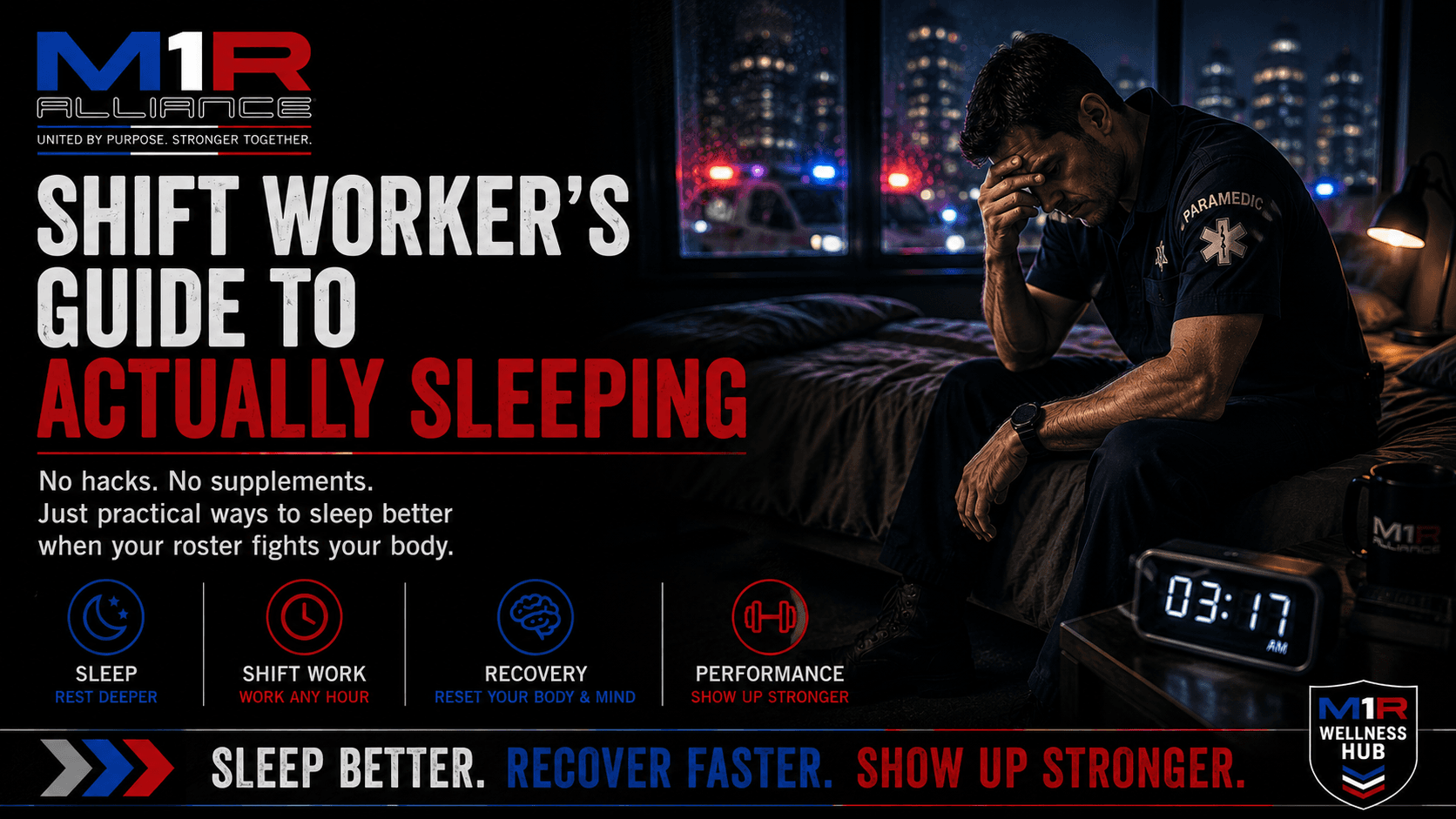
Nobody warns you that the hardest part of the job might be lying in a dark room at 10am, curtains taped to the wall, brain still running the last call. You did the shift. You got home. And now the one thing your body is screaming for is the one thing it won't do.
If you've worked rotating rosters, nights, or come off a deployment where sleep was a luxury you rationed, you already know this. Bad sleep isn't a personality flaw and it isn't weakness. It's what happens when you ask a body built around a 24-hour clock to work against it, week after week, for years. The good news is that a lot of it is fixable — not to perfection, but enough to change how you feel.
Why shift work hits so hard
Your body runs on a roughly 24-hour internal clock — the circadian rhythm. It decides when you're alert, when hormones fire, when your core temperature drops for sleep. It takes its main cue from light. When you work nights, you're awake in the dark and trying to sleep in the daylight, which is exactly backwards from what that clock expects.
So your body fights you. You feel wired when you should be winding down and flattened when you need to be sharp. Rotating rosters are worse again, because just as you start to adjust, the roster flips and you're re-learning the whole thing. It's like permanent jet lag without ever leaving the country.
This isn't just about feeling tired. Chronic short sleep changes your judgement, your reaction time, your mood and your patience. It nudges up your risk of the big health problems over the long run. And in frontline work, a tired decision can be an expensive one. Treating sleep as optional is treating your own edge as optional.
Sleep debt is real, and you're carrying it
Every hour of sleep you miss doesn't just vanish. It stacks up as sleep debt, and the bill comes due in the form of microsleeps, short fuses and that flat, grey feeling where nothing lands. Most people who've done years of shift work are walking around with a debt they've stopped noticing because it's become their normal.
You can't bank sleep in advance, but you can absolutely go bankrupt on it. The goal isn't a perfect eight hours every night. It's stopping the debt from spiralling.
Here's the reframe that helps: you're not chasing textbook sleep. You're managing a resource under difficult conditions, the same way you'd manage fuel, ammunition or your crew's energy on a long job. Small, consistent moves beat one heroic effort.
Get the light right
Light is the single biggest lever you have, because it's what your clock listens to. Use it deliberately.
- Coming off a night shift: wear sunglasses on the drive home. Bright morning light tells your brain it's daytime and to stay awake — the opposite of what you want when you're about to sleep. Cutting that light on the way home makes it far easier to drop off.
- When you need to be alert: get bright light early in your waking window. If you're on days, that's morning sunlight. If you're nocturnal for a run of nights, bright light at the start of your shift helps shift the clock.
- The hour before sleep: go dark. Dim the lights, drop the phone brightness, and stop scrolling. Screens right up against your face at full brightness are a signal to stay awake.
Make the bedroom a cave
If you sleep during the day, the room has to lie to your brain and say it's night. Blackout curtains or a good sleep mask. Cool temperature — most people sleep better a few degrees colder than they'd guess. Quiet, or a fan or white noise to cover the sound of the world going about its day. Phone out of reach, or at least face down and silenced. The bed is for sleep, not for lying there refreshing your emails.
Time your caffeine like a tool, not a reflex
Caffeine works, which is exactly why it's dangerous when you use it on autopilot. It has a long tail — half of that servo coffee is still in your system five to seven hours later. That 3am brew to get through the back end of a night shift can be the reason you're staring at the ceiling when you finally get home.
- Use caffeine early in your shift when you need the lift most.
- Cut it off well before you plan to sleep — aim for at least six hours clear, more if you're sensitive.
- Don't stack it late "just to get through." That's borrowing alertness now and paying it back with a wrecked sleep.
Same logic with alcohol, by the way. It might knock you out faster, but it shreds the quality of the sleep you do get, so you wake up feeling like you barely slept. It's a sedative, not a sleep aid.
Build a wind-down you'll actually do
You can't sprint from a high-adrenaline shift straight into sleep. Your body needs a runway. The mistake is thinking wind-down has to be some elaborate routine — it doesn't. It just has to be consistent enough that your brain learns the sequence means "we're done now."
Keep it simple. A shower. Lights down. Ten minutes of something boring and analogue — a book, not a screen. Some slow breathing to pull yourself out of threat mode. If your head is still running the shift, get it out of your skull and onto paper: a quick list of what's on your mind and what you'll deal with tomorrow. Not a diary of everything that happened — just a brain-dump so you're not holding it all awake.
If your mind won't switch off, the problem usually isn't your mind. It's that you gave it no signal the day was over. Build the signal.
Nap like it's a skill
Naps are a legitimate weapon for shift workers if you use them properly. A short nap — around 20 minutes — before a night shift can take the edge off without leaving you groggy. A longer nap of about 90 minutes lets you complete a full sleep cycle, which is better than getting stuck halfway. What flattens you is the in-between: waking mid-cycle, foggy and worse than before. Set an alarm, keep it deliberate, and don't nap so late in your off-time that it steals your main sleep.
Protect your days off
The temptation on a day off is to flip completely back to a normal schedule to "be a human again." That's understandable, especially with family. But whiplashing your clock back and forth is part of what keeps you exhausted. Where you can, keep your sleep and wake times a bit more consistent, even on the transitions. You don't have to be rigid about it — just avoid swinging five or six hours in either direction every few days.
And guard the sleep you do get. Tell the people around you what you need. A partner who understands that your daytime sleep is not negotiable, a note on the door, a phone on do-not-disturb — these small bits of respect for your own recovery add up. You'd protect a mate's rest before a big job. Protect your own.
When it's more than shift work
Sometimes the problem isn't the roster. If you're lying awake replaying jobs, waking with your heart pounding, or the sleep just won't come no matter what you do, that can be a sign of something deeper — stress, anxiety, trauma that hasn't been dealt with. That's not a character issue and it's not something to white-knuckle forever.
This isn't medical advice — it's one bloke's take built on lived experience and a lot of conversations with people who've been there. If sleep has become a genuine battle, talk to your GP, and know that support is there any time: Lifeline 13 11 14 and Open Arms 1800 011 046 are free and open 24/7.
When you wake at 3am and can't get back
Waking in the small hours is normal — everyone surfaces between sleep cycles. The damage is in what we do next: check the clock, do the grim maths on how little sleep is left, and switch on the exact stress response that guarantees we stay wide awake. So the first rule is simple. Turn the clock away from you. If you can't see the time, you can't spiral about it.
If you've been lying there wired for what feels like twenty minutes or more, stop fighting it in the bed. Get up, move to another room, keep the lights as low as you can, and do something deliberately boring — not the phone, not the news, not anything throwing light at your face. Read a few pages of something dull under a dim lamp until your eyelids get heavy, then go back. You're teaching your brain that the bed is for sleeping, not for lying there switched on and filthy about it.
Here's the cruel paradox of sleep: trying harder makes it worse. The more you strain to force yourself under, the more alert you get, because effort is the opposite of rest. So take the pressure right off. Tell yourself that simply lying there calm — warm, still, eyes shut, breathing slow — is doing your body real good whether or not sleep comes. Nine times out of ten, the moment you stop chasing it, it wanders in on its own.
Slow breathing helps here more than anything. Long, easy exhales pull your nervous system out of alert mode. You're not trying to knock yourself out — you're just dropping the revs so sleep has room to happen. A few quiet minutes of that beats an hour of lying there tense and annoyed at the ceiling.
And if you keep waking because your head's running a job or a worry on a loop, that's your signal to do the brain-dump earlier in the night. Get it out on paper before bed so it can't ambush you at 3am. If it still turns up, keep a notepad by the bed — write the thought down so your brain knows it's captured and safe to let go of until morning. Half the battle is convincing your mind it doesn't have to hold everything all night long.
Start with one thing
Don't try to fix all of this tonight. Pick one lever — the sunglasses on the drive home, the caffeine cut-off, the blackout curtains — and run it for two weeks. Sleep responds to consistency, not intensity. Get one thing working, then stack the next.
You look after your crew, your family, your community. Sleep is how you keep the tank full enough to keep doing it. Backing our own starts with backing yourself enough to rest.