
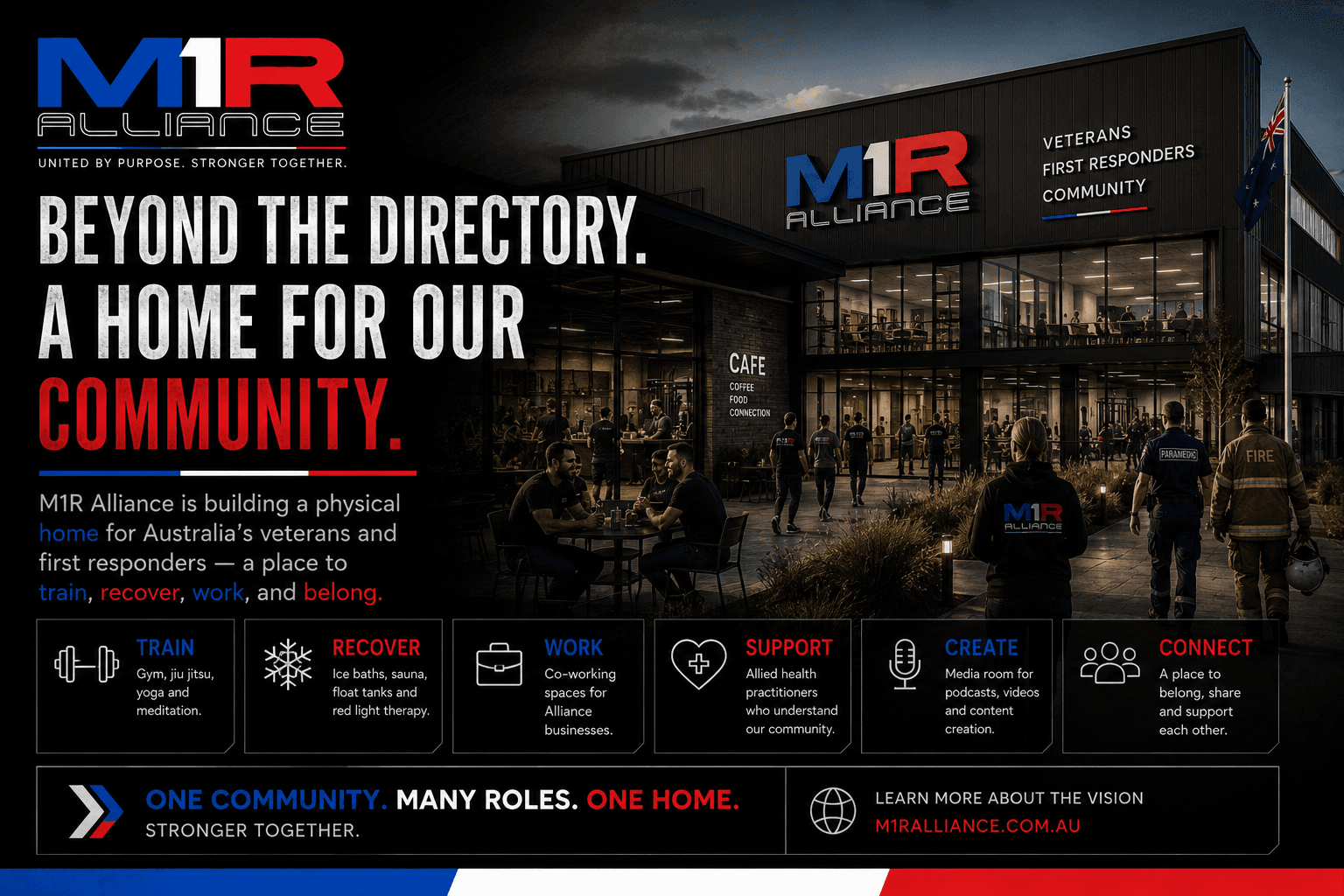
When most people hear "M1R Alliance", they think of the online directory. Veterans, first responders and their families finding trusted Aussie businesses run by people who've served. Supporter businesses pledging to give back. A digital network linking the people who've held the line with the businesses that back them.
That's true. That's where we started. And it's working.
But the directory was never the destination. It was the foundation.
The real vision is bigger, and it doesn't live on a screen.
What we don't talk about enough
Most of us — those who've worn the uniform, run with the squad, answered the calls others won't — have a thing in common that we don't always name.
When the service ends, the community ends too.
You leave the unit, the station, the squad. The rhythm of being around people who understand without needing it explained — gone. The dark humour that only works because everyone in the room has seen what you've seen — gone. The thousand small things that built the bond — the early starts, the rituals, the shared losses, the inside language — all gone.
You get a handshake, a piece of paper, and a Tuesday morning where you wake up and realise you don't quite know what you are anymore.
This isn't a complaint. Every service member who's transitioned knows the story. We all find our footing eventually. But the shape of the loss is real, and we don't talk about it enough.
The M1R Alliance directory was step one in fixing that. A way to find the businesses run by people who get it. A way for those businesses to find each other. A way for the rest of Australia to back them with their dollar.
But people don't belong to a directory. They belong to a place.
The vision: a physical home
Imagine this.
You roll up on a Tuesday morning. Maybe you've been struggling. Maybe you've been doing well but want to be around your people. Maybe you just want a coffee.
You walk in. The cafe out the front isn't a Starbucks. It's a small corner with good coffee and decent food, and the people behind the counter know your name. Half the people at the tables you recognise — either personally or by the look of someone who's worn the same uniform you did, served in similar places, carries the same things.
You sit down. Someone you know comes over. Or someone you don't, but they nod the nod and you nod back, and that's an entire conversation. You sit. You drink coffee. You're in.
After coffee, maybe you head out the back.
The gym is full of people who train hard, not for Instagram. Squat racks, kettlebells, rower. No music with bro-vocals. Just iron and breathing and the kind of grunting that doesn't need explaining.
Off to one side, the jiu jitsu mats. Someone's rolling. You can throw a gi on and join in. You can sit on the edge and watch. You can spar with someone you've known for ten years or someone you met five minutes ago — the mats don't care.
Down the hall, the yoga and meditation room. Quiet. Mats. A bench. Whether you're working through something, recovering from a session, or just need an hour of silence — it's there. No one asks. No one judges.
Around the corner: recovery. Ice baths cold enough to fix anything. A float tank for the days you need to disappear for an hour. Sauna. Red light therapy. The infrastructure your body wants but most facilities make you go to four different places to get.
Past that, the co-working space. Desks. Meeting rooms. A handful of M1R Alliance business owners working away. Some you know. Some you don't. You sit down at a hot desk and crack open the laptop. Around you, other Alliance members are running their businesses — financial advisor on a call, tradie sorting his weekly quotes, consultant on a deep work session.
When you stand up to grab a refill, you bump into another business owner. You mention the cashflow problem you've been wrestling with. They've been through the exact same thing two years ago. They tell you what worked. You file it away. The conversation costs nothing — and saves you six months of figuring it out alone.
Walk through to the next zone: the allied health practitioners. A psychologist who works specifically with veterans and first responders. A physio who treats the bodies that didn't get to be gentle on themselves for decades. Personal trainers who know what loading a body that's been broken and rebuilt actually requires.
Here's the part that matters: you can go from a jiu jitsu roll to a psychology appointment to a coffee with mates to a workout to an ice bath — all in the same building, on the same day, surrounded by the same people. Getting treatment isn't a thing you sneak off to do somewhere else. It's just another room. Another normal Tuesday.
That's the point.
Round the back, a media room. Quality lighting. Audio kit. Backdrop. Cameras. M1R Alliance businesses come in to record podcasts, film YouTube videos, produce content for social. Most veteran and first responder businesses can't afford a proper studio. We don't want that to be a barrier. Book the room, set up your shoot, knock out your content. Walk back to your desk and edit.
That's the building.
Why this changes everything
Here's what we know — and what most of the support infrastructure for veterans and first responders has missed.
The reason people don't get help isn't that the help isn't available. It's that the help happens somewhere separate. You have to go to the clinic. Sign in. Sit in the waiting room. Tell the receptionist what you're there for. Sit with the discomfort of being identified as someone who needs help.
For service members, that often means we just don't go.
But if the help is just another door in a building you're already in for ten other reasons — to train, to work, to grab a coffee, to roll on the mats — then walking through that door becomes nothing. It's just a Tuesday afternoon. You came in for a workout. You're staying for a psych appointment. You're heading down to the cafe afterwards to sit with mates.
That's how we normalise something that should never have been weird in the first place.
We need to stop treating "getting help" as a separate, special, slightly shameful event. It needs to be braided into the same rhythm as training, working, eating, hanging out. Not because the help is less serious — but because the act of getting it needs to be ordinary.
A physical home for M1R Alliance does that.
Why this needs all of us
This vision doesn't get built by one person, or one foundation, or one philanthropist. It gets built by the Alliance.
The more veterans and first responders who join the community — the stronger the case for the space.
The more businesses who list on the directory — the more revenue that flows back into the network, the more we can fund.
The more supporter businesses who back what we're doing — the faster we get from vision to bricks and mortar.
The more allied health practitioners, trainers, coaches and operators who put their hand up — the richer the eventual offering.
This isn't a charity ask. It's an invitation to belong to something that, in five years, will be the kind of place we wish had existed when we left service.
Call to action — be part of this
If you're a veteran or first responder, or family of one — join the Alliance. Get on the directory. Sign up to the newsletter. Be part of the network now while we're small enough that every member shapes what comes next.
If you run a business — whether you've served or you support those who have — list your business on the directory. The supporter network is what will fund this vision into existence. Every listing is a vote of confidence that this is worth building.
If you've got skills, premises, expertise, or just want to be involved when this gets serious — subscribe to the newsletter. We'll send updates as the vision moves from words to plans to walls. The early people who get involved now are the ones whose imprint will be on this thing forever.
Head to m1ralliance.com.au to:
Sign up to the newsletter and stay across the build.
List your business on the directory.
Find businesses run by people who've served.
Become a supporter business.
The directory is online now. The physical home is on the way. But the speed at which we get there is determined by how many of us are standing together when we start.
We've all been part of something that mattered before. We can be again.
Together — that's the whole point.