
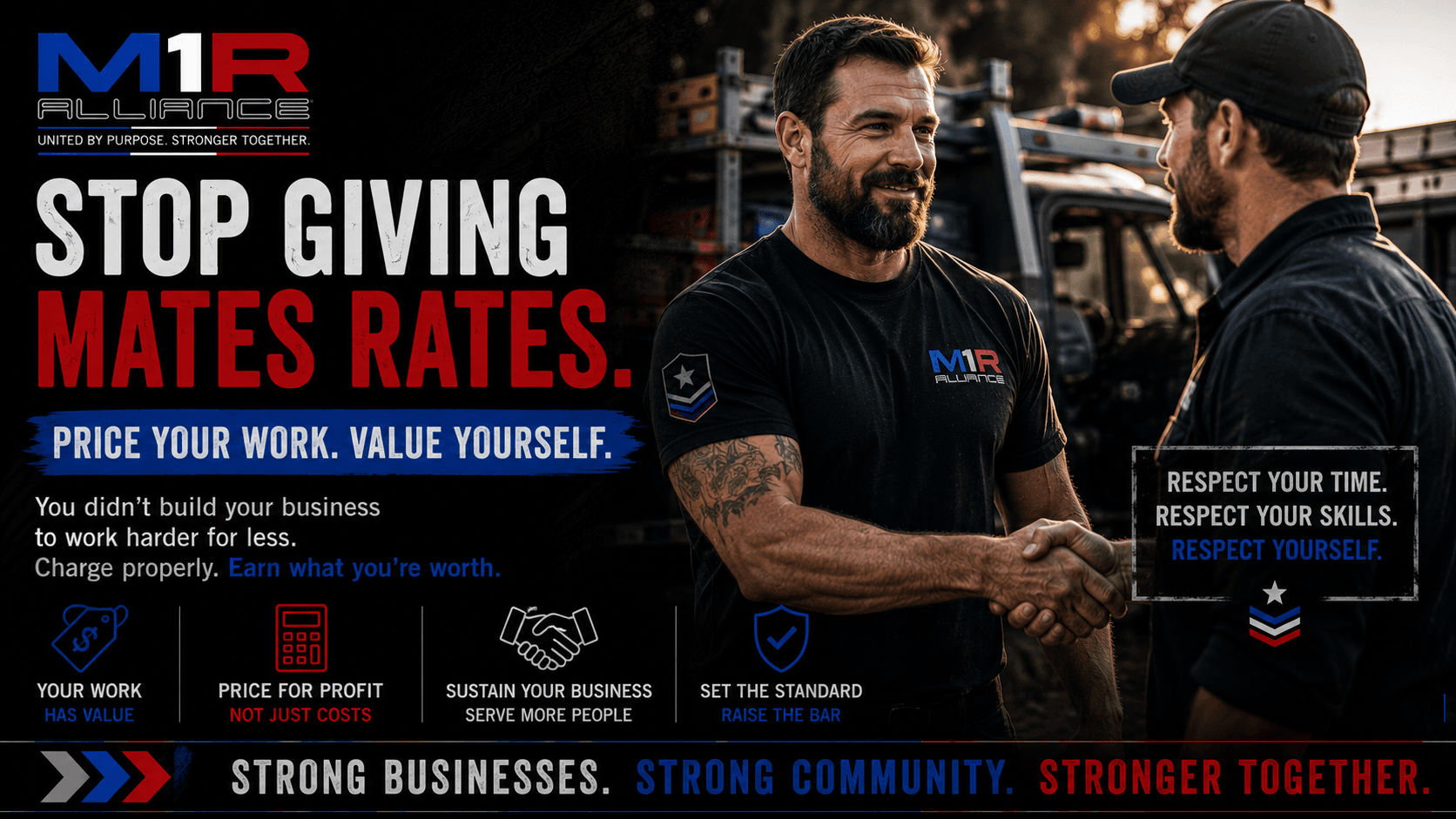
Here's a pattern I've watched play out too many times. A veteran or first responder starts a business, does genuinely excellent work, everyone loves them — and eighteen months later they're exhausted, broke and wondering why it isn't working. Nine times out of ten the problem isn't the work. It's the price. They're the best operator on the job and the cheapest, and those two things together are a slow way to go out of business.
Underselling yourself is the quiet killer of good businesses run by good people. Let's fix it.
Why we do it
This isn't a random flaw — it comes straight from where you've been. Service culture drills humility, service and putting others first into you, and those are good things right up until they hit an invoice. Then they turn into a reluctance to charge properly that feels like decency but functions like self-sabotage.
- Charging feels greedy. You were never in it for the money in the job, so asking for good money now feels off, almost dishonourable.
- You don't want to let people down. A higher price might mean someone says no, and disappointing people cuts against everything you're wired for.
- You undervalue your own expertise. Because a skill comes easily to you, you assume it's not worth much. It is. Easy for you is often impossible for the customer — that's the whole point.
- Mates' rates for everyone. You extend the discount you'd give a mate to total strangers, by reflex, before anyone even asks.
Undercharging isn't generosity. It's a slow way of going out of business — and a business that closes helps nobody, least of all the community you wanted to serve.
What cheap pricing actually signals
Here's the counterintuitive bit that trips people up. Being the cheapest doesn't just cost you margin — it can cost you the customer. Price is a signal, and a low price often reads as low value.
When someone's choosing who to trust with something that matters — their home, their health, their business — bargain-basement pricing can make them nervous, not keen. They wonder what the catch is. Meanwhile you attract the exact customers you don't want: the price-shoppers who'll haggle you down further, question every invoice and leave the moment someone cheaper turns up. The customers who value quality and pay for it? They often skip right past the cheapest option, because cheap makes them suspicious.
Price with a bit of confidence and you signal "I'm good, and I know it." That attracts better customers who are a pleasure to work with and stick around. You can genuinely price yourself into a worse business.
Price on value, not just cost
Most people who undercharge are pricing off cost — materials, hours, a modest margin — and stopping there. That leaves money on the table, because customers don't buy your costs. They buy the outcome and the peace of mind.
What's the outcome worth to them?
A customer isn't paying for the two hours you spent. They're paying for the problem going away, done right, by someone they can trust, so they never have to think about it again. That's worth far more than your hourly cost, and it's fair to price for it. The plumber who fixes it once, properly, is worth more than the one who's cheaper and back next month — and should charge like it.
What's your reliability worth?
We covered this in another piece: your follow-through is rare. When a customer knows you'll actually show up, do what you said, and stand behind it, that reliability is a premium product in a market full of no-shows. Don't give it away for the same price as the cowboys.
How to actually raise your prices
Knowing you should charge more and doing it are different things. Here's the practical path.
- Work out your real numbers. Know your true costs, including your own time valued properly, plus a margin that lets the business grow and survive lean months. You can't price with confidence if you don't know your floor.
- Research the market. Find out what good operators in your field actually charge. You'll usually discover you're well under. That's your evidence.
- Raise it in steps if you need to. You don't have to double overnight. Lift prices on new customers first, then bring existing ones along. Each rise gets easier once you see the sky doesn't fall.
- State the price plainly and stop talking. The biggest tell of an underseller is over-explaining and apologising for the price. Name it, calmly, and go quiet. Let it sit. Confidence is contagious; so is doubt.
- Be ready to lose the wrong ones. If a price-shopper walks, that's the system working. You're clearing room for the customers who value what you do.
Say the number, then shut up. The person who explains and apologises for their price has already told the customer it's too high.
Discounts done right
None of this means never discounting. In this community, offering a genuine discount to veterans and first responders is a good and meaningful thing — it's part of backing our own. The key is doing it deliberately, not by reflex.
- Make it a real, specific offer, not a vague "I'll look after you." A clear community discount is respected. A mushy everything's-negotiable stance just trains everyone to haggle.
- Discount from a proper price, not from an already-too-low one. A discount off a fair rate is generous. A discount off a bargain rate is just working for free.
- Give it to the people it's meant for, and hold your standard rate for everyone else without guilt.
Done this way, a discount becomes a genuine act of support you can afford to keep offering — because the business underneath it is healthy. That's the whole point.
Handling the "that's a bit steep" moment
Sooner or later someone pushes back on your price. For the chronic underseller, this is where it all falls apart — the flinch, the apology, the instant discount to make the discomfort go away. Don't. A price objection isn't an emergency. Handled with a bit of calm, it's just part of the conversation.
First, don't take it personally and don't rush to fill the silence. When you've named your price, stop talking. Let it sit. A lot of "that's a bit steep" is just a reflex, and if you don't cave in the first three seconds, plenty of people talk themselves straight back into it.
Second, if they genuinely want to negotiate, change the scope, not the price. Offer to do less for less, rather than the same work for a discount. "I can bring that down by trimming this part" keeps your rate intact and teaches the customer that quality has a cost. Caving on price for the exact same job just tells them your first number was a try-on.
Third, be genuinely willing to let the wrong ones walk. Not every customer is your customer. The person hunting the lowest number was never going to value your work anyway, and chasing them with discounts only fills your book with the exact people who'll haggle every invoice and vanish the moment someone cheaper turns up. Letting them go is the system working, not failing.
Raise your prices without losing sleep
If you know you're under — and most of us are — the fear of raising prices can be paralysing. You picture every customer walking out the door at once. It almost never happens. Do it in steps and it's far less frightening than the story in your head.
Lift your rate on new customers first, where there's no history and no awkwardness — just quote the new, fair number and watch the sky stay exactly where it is. Once you've seen good customers pay it without blinking, bringing your existing ones along gets a lot easier. Give them fair notice, thank them for their business, and hold the line. The ones worth keeping will stay; the few who leave over a fair rise were the low-margin, high-maintenance ones anyway, and their leaving makes room for better.
Every operator who's done this says the same thing afterwards: they wish they'd done it sooner, and the disaster they feared never turned up.
Charge like you intend to stick around
The mission here isn't to squeeze every dollar. It's to build something that lasts, so you can keep doing good work and keep supporting your people for years, not months. A business that undercharges its way into the ground serves nobody. Charging properly is what keeps you in the fight.
So back yourself. Value your expertise, price for the outcome, say the number without flinching, and offer your community discount from a position of strength. You've spent your life being worth more than you were paid. Now you get to set the rate. Set it like you mean to be around next year — because this community needs good operators who stay in business. One team, one mission, one alliance.