
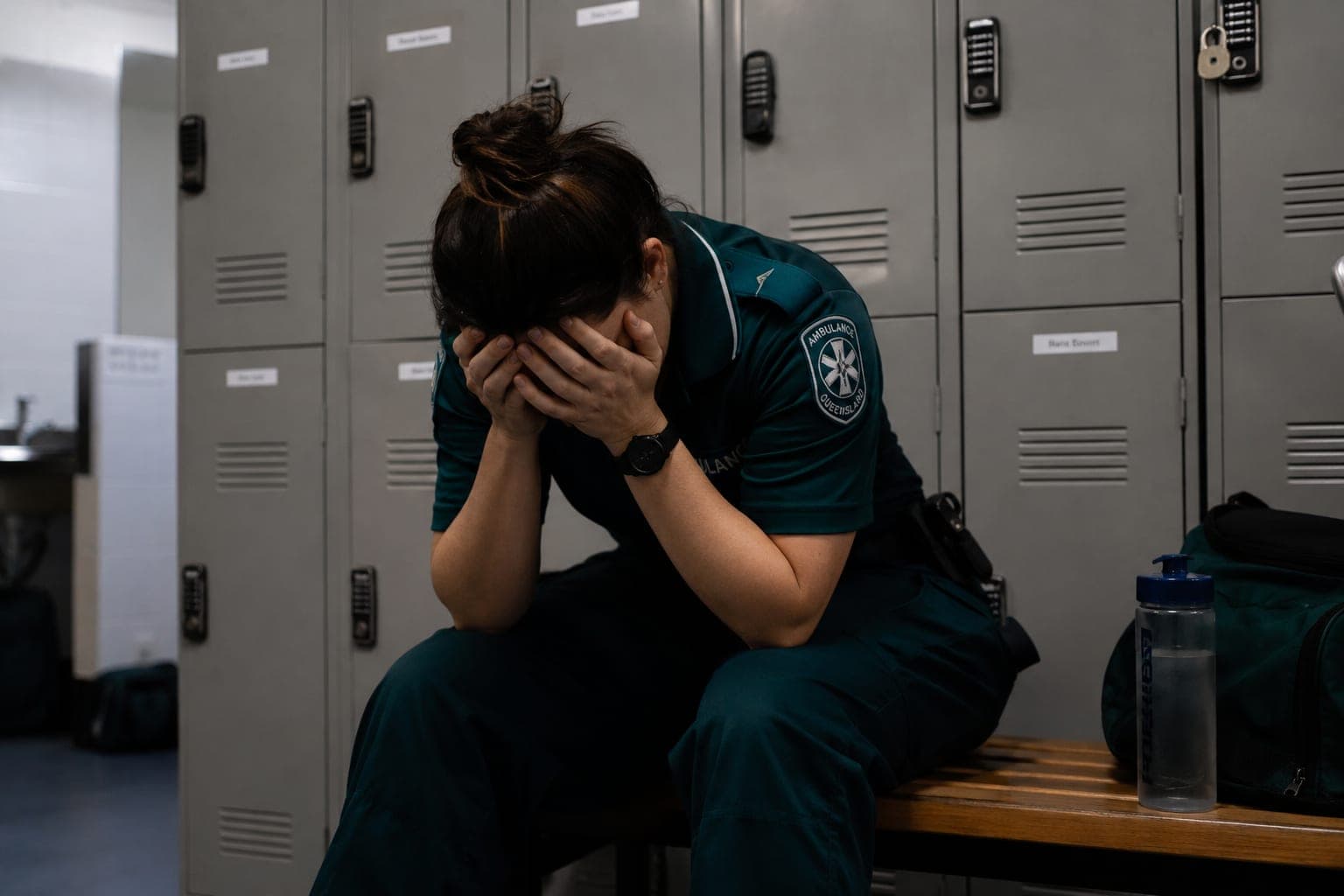
There's a particular pause that happens in a conversation when someone you served with is in trouble and you both know it and neither of you wants to be the one to bring it up.
If you've spent any time in uniform, you know exactly the pause I mean. The mate who didn't show up to a barbecue. The text reply that came back too quickly and a little too cheerful. The way someone laughed at the wrong moment in a story. The way they stopped laughing at all.
We are extraordinarily good at noticing tiny tells in strangers — that's the job. We are catastrophically bad at noticing them in each other.
This is a piece about how to fix that. How to spot post-traumatic stress in a mate, or in yourself, before it does the kind of damage that takes years to unwind.
I wrote about my own breakdown in the M1R Alliance founder story. The short version: I went years without recognising what was happening to me, until my body forced the issue in late 2016. I don't want anyone else to wait that long.
So here's the field guide I wish I'd had.
What PTSD actually looks like (and what it doesn't)
Most people picture PTSD as the cinematic version. A veteran ducks at the sound of a car backfiring. A firefighter wakes up screaming. A flashback hits and they're back in the moment.
Those things happen. But they are the loud, late-stage symptoms. By the time the person you care about is having a flashback, you missed a hundred quieter signs along the way.
The quieter signs are the ones that matter. They look like normal life going slightly wrong.
The clinical definition of PTSD has four buckets — intrusion (unwanted memories, dreams, replays), avoidance (staying away from anything that reminds you), negative mood and cognition (guilt, shame, detachment, loss of joy), and hyperarousal (irritability, sleep problems, hypervigilance, exaggerated startle).
Knowing those four words isn't useful unless you know what they look like in the kitchen, in the car, at the work Christmas party, in the silence after a hard shift. That's what the rest of this piece is about.
The signs in yourself
Self-detection is hard because the same trait that makes you good at your job — being able to compartmentalise, push through, function while broken — is the trait that hides PTSD from you.
Here's what to ask yourself. Not as a checklist to score. As a series of honest gut-checks.
"I'm fine" has become your default
You've said it so many times you don't even hear yourself saying it anymore. The truth is somewhere closer to "I'm wrecked and I don't know how to say that without it costing me something." If "I'm fine" is on automatic, that's a sign.
You're calibrating your day around your symptoms
You used to go to the cafe in town. Now you go to the quiet one out of the way. You used to sit anywhere. Now you only sit facing the door. You used to fly economy. Now you can't bring yourself to sit between two strangers.
Each individual adjustment is rational. Stacked together, they're a map of your hypervigilance.
Your home life has changed and you can't quite say why
The kids' noise reads as input you can't process. Your partner is "off" — when actually you're the one who's off and they're reacting to it. You're working harder to feel okay around the people who used to make you feel okay automatically.
That's not a relationship problem yet. That's an unmanaged trauma problem that becomes a relationship problem if you leave it.
You're sleeping like someone in a war zone
Sleep is the canary. PTSD wrecks it before anything else. You're either struggling to get to sleep, waking up at 3am with your mind running, dreaming things you don't want to talk about, or all three.
If you've started telling yourself "I just don't need much sleep these days" — that's not a sleep change. That's a coping mechanism dressed up as an explanation.
You can't remember the last time something landed
You laughed. You ate. You went to a kid's birthday party. You did everything correctly. But none of it landed. You went through the motions and watched yourself going through them.
That detachment is what clinicians call dissociation. It's protective in the short term and corrosive over years.
Your coping has crept
A drink after work has become two. Two has become four. Or it's not alcohol — it's scrolling, gambling, work, running, gym, anything that drowns out the noise. The coping isn't the problem on its own. The problem is when the coping starts costing you something — sleep, money, your relationships, your time with your kids — and you keep doing it anyway.
If you read those six and three or four felt uncomfortably familiar, that's worth a conversation with a GP this week. Not next month. This week.
The signs in a mate
This is harder, because you're working from the outside. You can't see what's happening inside their head. But you can see behaviour. Behaviour leaks.
They've gone quiet
The mate who used to be in the group chat is suddenly only in the read receipts. They cancel plans they used to be reliable for. They reply "yeah maybe next week" and next week never comes. They've not had a fight with anyone — they've just slowly become harder to find.
This is the single most under-noticed sign because it doesn't look like a sign. It looks like life getting busy.
Their humour has changed
Black humour is part of the job. You know what your mate's normal black humour sounds like. What you're listening for is a shift — darker, more nihilistic, more dismissive of things they used to care about. Or the opposite: the humour has just gone. They used to be the one who broke the tension in the room and now they're the silence in the corner.
They're physically different
Weight up or down. Posture has slumped. They look tired in a way that isn't fatigue. Their handshake is different — softer, or harder. They've stopped looking after themselves in small ways that used to be automatic.
They're flinching at things
A door slams. A car backfires. Someone walks up behind them at a barbecue. You see the reaction before they get it under control. They cover it well — that's the training. But you saw it.
Their lives have started cracking
Out of nowhere a long marriage ends. They quit a job they were good at. They've moved house three times in two years. They've had a "minor" car accident that wasn't really minor. They've had a health scare. The cracks are showing up in places that aren't directly the trauma but are absolutely downstream of it.
When you start putting the changes together, the picture is almost always there. Most people don't put them together because each individual change has a plausible explanation.
That's the whole game. The plausible explanations are how PTSD hides in plain sight.
The myths that stop people seeing it
A few stories the community keeps telling itself that get in the way of recognising what's happening.
"He's been through worse than this and he's fine." Cumulative trauma doesn't care about the scale of any single event. The straw that breaks the camel's back is rarely the heaviest straw.
"She's not the type." There is no type. PTSD doesn't sort by gender, rank, experience or personality. The hardest-charging operator in your old unit and the calmest paramedic in your station are both candidates.
"He'd tell me if he wasn't okay." No, he wouldn't. The reason he hasn't told you is because he doesn't know how, or he's worried what it'll cost him, or he doesn't want to make it real by saying it out loud. You'll need to start the conversation, not wait for it.
"It's only PTSD if there was a 'big one.'" There usually isn't a single big one. There's usually a hundred small ones plus a handful of medium ones plus the chronic stress of the job underneath all of it.
What to do if you think a mate isn't okay
There's a temptation to overthink this. Don't. The single most useful thing you can do is one specific conversation, repeated.
Ask the right question
Not "you okay mate?" — that gets a reflexive "yeah." Try: "I've noticed you've gone a bit quiet lately. What's actually going on for you?" The word "actually" does a lot of work. It signals you're not asking for the polite answer.
Sit with the silence
They will pause. The pause is the moment. Don't fill it. Don't tell them about your own thing to make them feel less alone. Just wait. Most people have never been asked the question with real intent. They need a second to figure out you mean it.
Don't try to fix it
You can't fix it in a conversation. What you can do is be the person who heard it without flinching. That alone is rare enough to matter.
Suggest one concrete next step
Not "you should get help." That's an instruction without traction. Try: "Would you be open to seeing your GP this week? I'll come with you if it helps." Or: "Have you heard of Open Arms? They do free counselling for veterans and their families." Specific. Actionable. Low-cost first step.
Follow up
Twice. Three times. Don't ask once and never again. The most lonely-making thing in the world is to open up to someone and then have them never bring it up again. A week later: "How did the GP thing go?" Two weeks after that: "Still thinking about you mate, how are things?"
Don't do this performatively
If you're checking in because it'll make you feel like a good mate, they'll smell it. Check in because you actually want to know.
What to do if you're the one not okay
I'm writing this part as someone who took years to do what I'm about to tell you to do. I'm not lecturing. I'm asking.
Step one — tell one person
Not your whole network. Not Facebook. One person you trust. Whoever that is for you. The act of saying it out loud to another human being is the first concrete piece of the recovery.
Step two — see a GP
Not because GPs solve PTSD on their own — they don't — but because a GP can put you on a Mental Health Treatment Plan that gives you ten subsidised sessions with a psychologist under Medicare. That's the gateway to the help that actually works. Tell them what you've been carrying. They've heard worse.
Step three — find the right specialist
Trauma-informed psychologist. EMDR-trained. Or someone who does CPT — cognitive processing therapy. Or someone who specifically works with veterans or first responders. Don't settle for the first GP referral if it doesn't feel right.
Step four — stack the small habits
None of these are the answer on their own. Stacked, over months, they become the answer. Sleep. Movement. Time outside. Stopping the coping mechanism that's costing you the most. Telling one more person.
Step five — keep going
PTSD recovery isn't linear. You'll have good weeks and weeks where you're sure none of it is working. Both of those are part of it. The work is in keeping going through the second type.
If you're in crisis right now — not next month, right now — call 000 if you're not safe, or Lifeline on 13 11 14 if you need to talk to someone tonight. Both are free. Both have heard exactly what you're about to tell them. Neither will judge you.
The non-negotiables
A few things, plainly.
You can't drink your way through this. Alcohol is the most-prescribed self-medication in the veteran and first responder community. It works for a few hours and then it makes everything worse. You can drink less and feel worse first. That's normal. Push through the first month.
You can't isolate your way through it. PTSD wants you alone. Don't give it what it wants. Even when you don't want to see anyone, see one person.
You can't think your way through it. You did not get into this trouble through faulty reasoning. You will not get out of it through better reasoning. The work is somatic — body, breath, nervous system — as much as it is cognitive.
You can't outrun the conversation forever. You can defer it. You can compartmentalise it. You can put more weight on top of it. But it doesn't get smaller. It just gets older. And old trauma is harder to treat than recent trauma.
Who this isn't for
This isn't a substitute for clinical advice. I'm a first responder and a founder, not a psychologist. If you read this and recognise yourself, the next step is a GP, not another article.
This isn't a checklist for a five-minute check-in. If you go through this in the carpark with a mate and tick three boxes and walk away, you've done nothing. The point of the field guide is to start a longer conversation. The conversation is the thing.
And this isn't for people who think being asked the question is offensive. If a mate of mine asked me "I've noticed you've gone quiet — what's actually going on?" I'd take that as the greatest gift another human can give. If you're worried about overstepping by asking, you're not the one I'm writing for. You're already the kind of mate that asks. Go ask.
What to do next
If you've read this far and someone came to mind — pick up the phone today. Not later this week. Today. The window for noticing closes faster than you think.
If you've read this far and recognised yourself — pick one of the five steps above and do it this week. One step. Not five. One.
If you want to keep getting straight talk like this in your inbox, join the M1R Alliance newsletter. One email a week. No marketing fluff.
And if you're a business that wants to back the community that does this work, look at the supporter tiers. Ten percent of every paid subscription goes directly to Aussie Frontline Foundation, which funds counselling sessions through Frontline Mental Health. Your subscription doesn't just buy you a listing — it funds the same kind of support that this piece is talking about.
The community looks after the community. That's the whole point.
No one should fight their battles alone.
— Jerry
If you need help right now
Lifeline on 13 11 14 — 24/7, free. Beyond Blue on 1300 22 4636 — 24/7, free. Open Arms on 1800 011 046 — free counselling for veterans and their families. Fortem Australia — first responder mental health and wellbeing. Frontline Mental Health — counselling specifically for first responders. And if it's an emergency, 000.
You don't have to face this alone. You were never supposed to.
Frequently asked questions
What are the early signs of PTSD in veterans and first responders?
Early signs are usually subtler than the cinematic flashback. The most common include sleep changes (insomnia, vivid dreams, early waking), hypervigilance (scanning rooms, sitting facing exits, exaggerated startle), social withdrawal (cancelling plans, going quiet on the group chat), increased reliance on coping behaviours like alcohol, irritability and short fuse, and a sense of detachment or emotional numbness.
How is PTSD different in first responders versus the general public?
First responders experience cumulative trauma — hundreds of incidents across a career rather than one or two over a lifetime. That means PTSD often builds slowly, and the trigger may not be a single "big one" but the weight of everything stacked on top of years of shift work, sleep deprivation and chronic stress.
How do I bring up PTSD with a mate without making it awkward?
Start with what you've actually noticed, not a diagnosis. "I've noticed you've been quieter lately — what's actually going on for you?" works because it's specific, it's about behaviour you've seen (which is hard to argue with), and it invites a real answer instead of the reflexive "yeah, fine."
Where can a veteran or first responder get free mental health support in Australia?
Open Arms (1800 011 046) provides free counselling for veterans and their families. Fortem Australia and Frontline Mental Health both focus on first responders specifically. A GP visit also unlocks ten subsidised sessions with a psychologist via a Mental Health Treatment Plan under Medicare. Lifeline (13 11 14) and Beyond Blue (1300 22 4636) are both free, 24/7 and judgement-free.
Does Jerry's story tie in here?
Yes. The M1R Alliance founder story walks through exactly what happened — including the warning signs Jerry himself missed for years before his diagnosis in 2016. If this article resonated, that piece is the next read.