
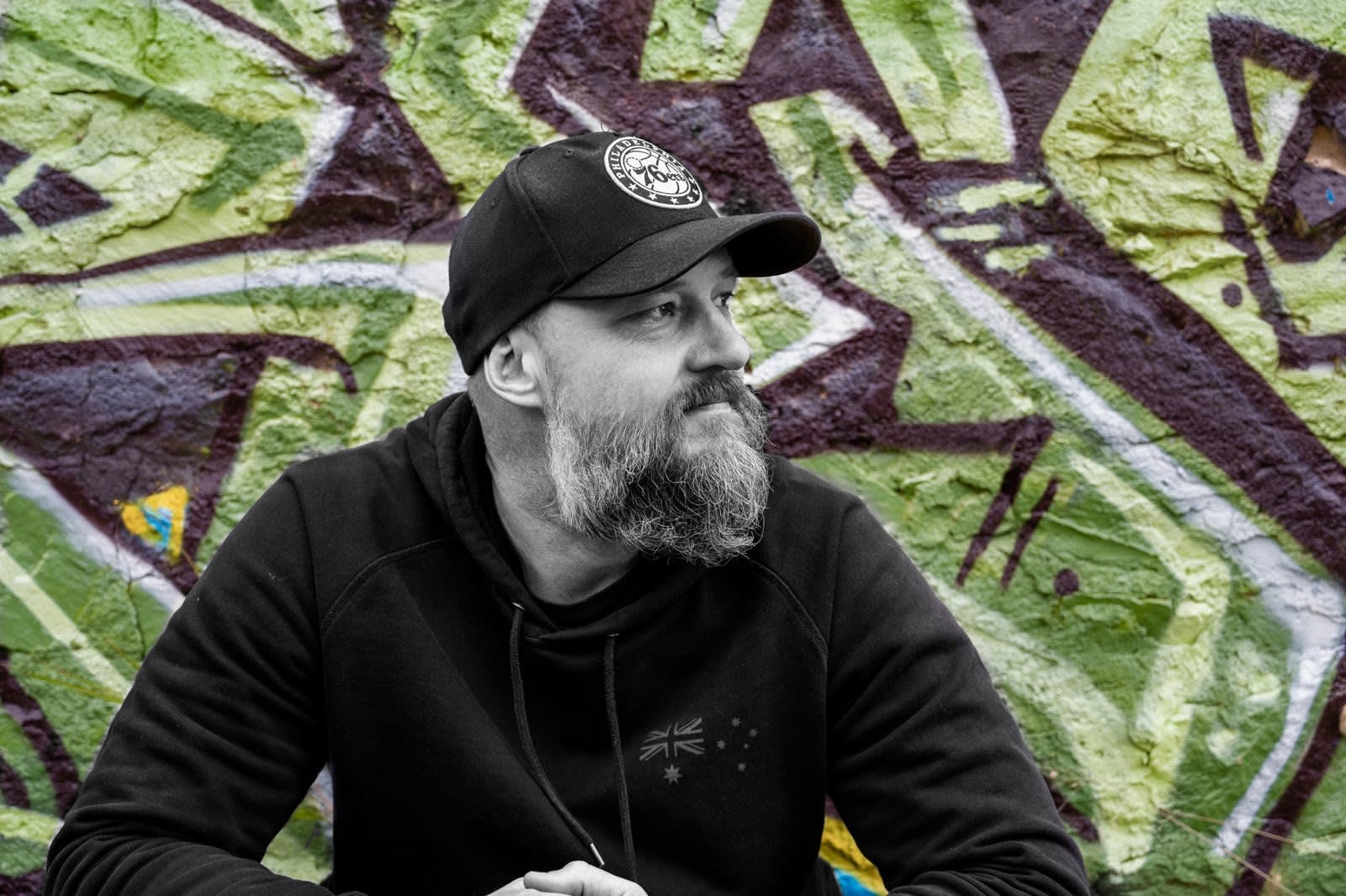
Late 2016. I'm in a hospital bed.
A door slams somewhere down the corridor. Before I know it, I'm on the floor, under the bed, convinced someone is shooting at me. I lie there for what feels like a long time, listening, waiting.
When the panic finally settles, I pull myself out from under the bed and sit on the edge of it. And in that moment, with my heart still going at twice its normal rate, I see something I haven't seen clearly in two years.
The man who tried to take my firearm in 2014 had been my attacker for maybe ten seconds of my life. I'd let him be my attacker for every minute since.
That was the day I decided I'd had enough of being his victim.
This is the story of what got me to that bed, and what got me back out of it. It's the story of why a 28-year first responder and former soldier ended up founding M1R Alliance — a place built so no one else has to make that journey alone.
Twenty-eight years of service
My name is Jerry. I'm a veteran, a first responder, a father of two, and the founder of M1R Alliance.
I joined the Australian Army in 1998. Four years posted in Queensland and South Australia, working alongside some of the most capable people I've ever met. They taught me the four values that still guide everything I do — trust, honesty, respect and service.
When I left the Army in 2002, I didn't take a break. I walked out the gate one Friday and started as a first responder the following week. I've been at it ever since. More than twenty-four years now.
I've worked critical incidents. Helped people on the worst day of their lives. Deployed overseas. One of the greatest honours of my career was serving with the Australian Federal Police Stability Response Team — Operations Response Group. In 2008 I deployed to Timor-Leste after the attempted assassination of President Ramos-Horta and Prime Minister Gusmão. I served in the Solomon Islands as part of RAMSI. Numerous national taskings in between.
I've loved this work.
I'm proud of the mates I've made, the missions I've been part of, and the small moments of being genuinely useful to someone who needed it.
But every veteran and first responder I know carries the same secret: there's a price.
The slow accumulation
The general public might experience two or three significant traumatic events in a lifetime.
A first responder can be exposed to hundreds across a career.
Violence. Tragedy. Death. Shift work. Sleep deprivation. Prolonged stress. It accumulates the way water builds behind a dam — quiet, invisible, until it isn't.
Early in my career, a member of the public tried to run me over with their car. I held it together for the rest of the shift. Did the paperwork. Briefed the next crew. Walked out to my car at end of shift like nothing had happened. Then I sat in the carpark and broke down. Couldn't tell you for how long.
I treated it like a bad day. I'd been taught to push through. Everyone I worked with had been taught the same thing.
So I pushed through.
For years. Through hundreds more incidents. Through deployments. Through the quiet erosion of whatever margin I'd been carrying when I started.
2014
A week before my second son was born, a man tried to take my firearm.
The incident itself was over in seconds. The damage took years to show.
I didn't crash all at once. I changed slowly, in ways I didn't recognise at the time. More cautious. Less willing to engage. I'd start taking the back seat — in vehicles, in conversations, in decisions I should have been making.
But when something did escalate, I had no middle gear. I could go from calm to highly reactive in a blink. My family started seeing the version of me that nobody at work was allowed to see.
Then, eventually, my body called time on the lie.
I was at work when it happened. Couldn't breathe. Couldn't speak. Felt like an elephant on my chest. I genuinely thought I was having a heart attack.
It was a severe anxiety attack.
That was the day I knew I needed help. It would still be two more years before I actually got it.
When the job comes home
PTSD doesn't stay at work. That's the part nobody warns you about.
After a long shift, I couldn't switch off. The normal noise of two young boys — the running, the wrestling, the spilt drinks, the bickering — it didn't read as childhood to me. It read as input my system couldn't process.
So I'd get angry. I'd withdraw. I'd find ways to numb out. Some of those ways I'm not proud of.
There were stretches where I wasn't the father I wanted to be. That's one of the hardest sentences I've ever written, and I'm writing it on purpose. Because every veteran and first responder reading this is doing the same calculation right now, and I want them to know they're not the only one who's done it.
The breaking point
Late 2016. Another workplace incident pushed me onto sick leave. The way the situation got handled made everything worse.
I won't go into the specifics. What matters is that what followed was the darkest period of my life.
I was hospitalised after coming very close to taking my own life.
Diagnosed with PTSD and major depression. Anxious, angry, isolated, disconnected from my family and friends, convinced that everything I'd built — career, identity, relationships — was slipping out of my hands.
I want to be careful here, because if you're reading this and recognising yourself, I don't want to skip past what it actually felt like. It didn't feel like sadness. It felt like everything around me had become unfamiliar, including me. Like I'd been replaced by a worse version of myself and there was no way back.
That's what I believed.
That's also what was wrong.
Under the bed
That day in hospital when the bang went off in the corridor was the day I started believing differently.
I lay under that bed for a while. And when I climbed back out, something in my head had shifted.
The man who attacked me in 2014 had been my attacker for maybe ten seconds. I'd let him be my attacker for every day since. I'd let that ten seconds dictate how I parented, how I worked, how I spoke to my wife, how I felt in my own house.
I decided in that moment I wasn't doing that anymore.
I wasn't choosing whether to recover. I was choosing whether to live as a victim of that ten seconds or to live as something else.
That's where post-traumatic growth begins. Not at the moment of trauma. At the moment you decide what the trauma gets to mean.
What actually worked
I'm wary of recovery stories that read like a smoothie recipe. Mine wasn't a recipe.
What it was, was a stack of small commitments I kept making, over years.
Psychological support — proper, ongoing, not "I'll go once and see how it feels." Yoga, because my body needed somewhere to put what my head couldn't. Breathwork. Meditation. Cold-water immersion. Cutting back hard on the coping strategies that were costing me more than they were giving me. Reconnecting with the values I joined the Army for in the first place.
None of these things on its own was the answer. Stacking them, week after week, year after year, became the answer.
What surprised me was that the work didn't just get me back to where I'd been. It got me somewhere better.
I'm more self-aware than I was at thirty. More present. More grateful. More deliberate about the kind of man I want to be. The trauma didn't give me those things — the work I did in response to it did. But I wouldn't have done the work without the trauma. That's the truth, and it took me a long time to be okay saying it.
The reason I get up
My two sons are everything.
Fatherhood gave me a purpose that no rank, no posting, no operation ever did. They taught me what actually matters — being present, laughing more, sweating less about things that won't matter in five years.
My measure of success now is simple. Are they proud to call me Dad? Not "did Dad have a big career?" Not "did Dad make a lot of money?" Just — am I the bloke they tell their mates about with a small smile?
That's the only KPI that matters.
Why M1R Alliance exists
M1R stands for Military and First Responder Alliance.
It started as a social media account. The goal was simple: tell my story openly so other veterans and first responders might find it easier to tell theirs.
I'd realised something while I was healing. Silence is the multiplier. When nobody's talking about what they're going through, every veteran sits in their car after a hard shift assuming they're the only one. Every spouse wonders why their partner came home different and doesn't know who to ask. Every kid feels the temperature drop in their house and doesn't have words for it.
The minute somebody breaks that silence, the room changes. Permission moves through the community like a current.
When I started posting, the response told me everything I needed to know. Strangers reaching out. Friends of friends. People still serving. People transitioning out. People who'd been out for ten years and still hadn't told anyone how they really were.
That's when M1R Alliance stopped being a personal project and started being something bigger.
What M1R Alliance does — in plain terms
Three things, all connected.
It builds community
No veteran, first responder or family member should feel like they're navigating any of this alone — mental health, business, transition, fatherhood, mateship. M1R Alliance is the meeting point for people who get it without needing it explained.
It backs veteran and first responder businesses
Plenty of people in our community go on to build excellent businesses after service. Most of them are invisible to the buying public because they're competing on Google against companies with marketing budgets they can't match. The directory fixes that. It's a place where the buying decision starts with "do I trust this person" rather than "do they bid high enough on AdWords."
It connects Australians who want to back our own
A lot of Australians want to support veterans and first responders. They just don't know how to find them when they need a tradie, a coach, a financial planner, a lawyer. M1R Alliance makes that easy — every business listed has been verified, and the Platinum Preferred tier means the community has put their name on the recommendation.
If you've served, your listing is free for life. That's not a discount; that's the deal. We won't ever charge a veteran or first responder for being part of this network.
If you're a business that wants to back the community, the supporter tiers start at $50 a month and 10% of every paid subscription goes directly to Aussie Frontline Foundation programs — including sponsored counselling sessions through Frontline Mental Health. Your subscription doesn't just buy you a listing. It funds the same kind of support that got me back on my feet.
The values underneath
Trust. Honesty. Respect. Service.
The Army gave me those four words in 1998. They guided me through twenty-six years of service. They guided me out of the worst stretch of my life.
They're the only values M1R Alliance is built on. If you can sign up for those, you'll fit in here. If you can't, you probably won't.
What I want every veteran and first responder to know
If you're struggling, you're not alone. Not statistically, and not personally. Someone you served with is in the same spot right now. They're not telling you, the same way you're not telling them.
If you feel overwhelmed, there is help. Real, practical, evidence-based help. Not toughen-up help. Not "have a beer with the boys" help. Proper help.
If you think no one understands what you're carrying — there is a whole community that does. We just have to find each other.
And if you believe your best days are behind you, they're not. They might just be starting from a different baseline than the one you imagined. Mine did.
PTSD does not have to be the end of your story. It can be the catalyst for the next chapter of it.
I'm not telling you that because it sounds nice. I'm telling you because it's what happened to me, and it can happen to you.
No one should fight their battles alone.
What I want this to become
The vision is simple.
Australia's most trusted community and business network for veterans, first responders and the Australians who back them. Where service is recognised. Where businesses owned by people who served are seen and supported. Where mental health conversations are normal, not whispered. Where families feel less alone. Where the community takes care of its own.
In-person events. State-by-state meet-ups. A directory you actually trust. A newsletter that lands like a mate emailing you. Discounts that make a real difference, not a 5% gimmick. Counselling sessions funded by every paid subscription.
The bigger we get, the more we can do. Every member, every business, every shared story makes this stronger.
How to get involved
If you've read this far, this isn't an abstract pitch to you anymore. You either care or you don't. So:
If you served — list your business free for life or join the newsletter. Share this with the bloke or woman from your old unit who's been quiet lately. You know who they are.
If you're a first responder — the listing is free for you too. Same deal. Forever.
If you're a business that wants to back our own — look at the supporter tiers. Application takes five minutes. Ten percent of what you pay funds counselling for the community you're trying to reach.
If you're family or a mate of someone who served — share this. Send it to them. It might land on a day they need it.
This isn't for you if you want a logo placement or a feel-good badge. It's for you if you want to be part of something that actually moves the needle.
If any of this hits close to home
If parts of this story felt familiar — please reach out. Don't sit with it.
Frontline Mental Health, Fortem Australia and Beyond Blue on 1300 22 4636 all specifically support first responders, veterans and their families. None of them will judge you. All of them have heard worse.
If it's urgent, call 000 or Lifeline on 13 11 14. Right now. Today.
You don't have to face this alone. You were never supposed to.
— Jerry
Frequently asked questions
What is M1R Alliance?
M1R Alliance — short for Military and First Responder Alliance — is an Australian community and business network for veterans, first responders, their families, and the Australians who want to back them. We connect the community, support businesses owned by people who served, and fund mental health programs through Aussie Frontline Foundation.
Who is M1R Alliance for?
Current and former military members, first responders (police, fire, ambulance, SES, corrections, emergency medical), their families, and businesses that want to genuinely support the community.
How does M1R Alliance support mental health?
Two ways. First, we donate 10% of every paid subscription to Aussie Frontline Foundation, which funds counselling sessions through Frontline Mental Health. Second, by building visible, honest community we work to dismantle the stigma that keeps people silent.
Can businesses join M1R Alliance?
Yes. Veteran-owned and first responder owned businesses list free for life. Supporter businesses (run by people who back the community without having served themselves) can join through paid tiers starting at $50 a month.
Why did Jerry start M1R Alliance?
After living through PTSD, depression and a near-loss in late 2016, Jerry built M1R Alliance from his recovery. The mission is to make sure no veteran or first responder has to navigate trauma, transition or building a post-service life alone.