
Last month a mate of mine — runs a roofing business in suburban Adelaide — sent me a screenshot of his Meta Ads dashboard. He'd just blown $4,200 on a "veteran-friendly tradies" campaign. Six leads. One quote. Zero jobs.
He asked me what he was doing wrong.
The short answer: nothing technical. The targeting was fine. The creative was fine. The landing page was fine. He was doing what every marketing agency tells you to do when you want to "reach veterans."
The problem is that veterans don't shop the way Meta thinks they shop. They don't shop the way most marketing playbooks assume anyone shops.
If you're a business that wants to win work from the veteran and first responder community in Australia, you need to understand how the market actually moves. Because almost everything you've been told about it is broadcast-era thinking applied to a closed-network audience.
The market is bigger than you think
Australia has around 600,000 veterans. Add serving and former police, fire, ambulance, SES and corrections, plus the immediate families of all of the above, and you're at roughly two million people who self-identify as part of the veteran or first responder community. Two million Australians.
That's bigger than the population of South Australia and Tasmania combined.
And every one of them has a buying journey for tradies, lawyers, brokers, cafes, gear, supplements, holidays and everything else.
The opportunity is real. The math on opportunity is not the problem. The problem is the path.
How the buying decision actually gets made
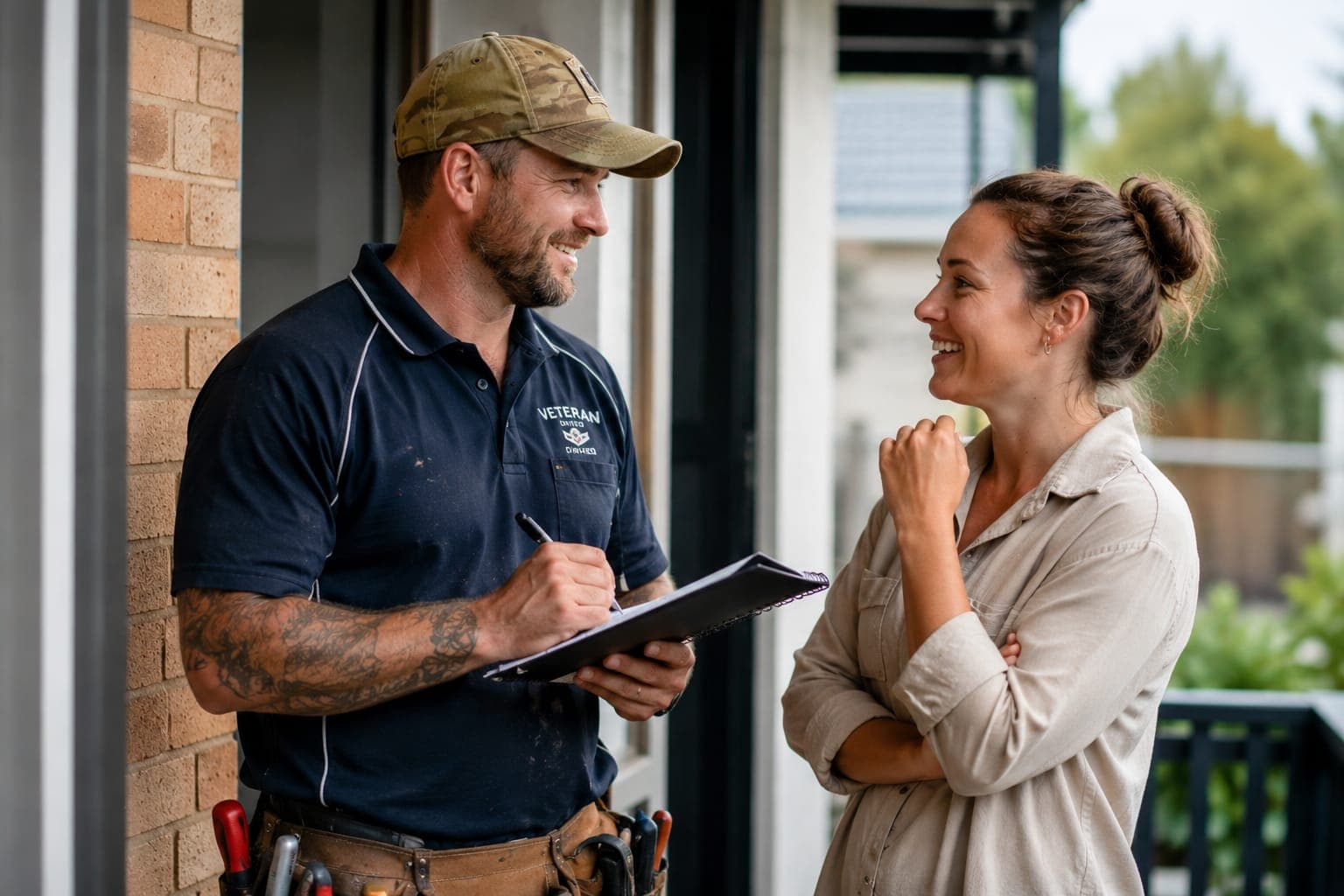
Here's what my roofing mate didn't account for. When a veteran or first responder needs a tradie, this is the order of operations:
**Step 1**: Ask the boys (or girls). A WhatsApp group of ten people. A Facebook group of 8,000. A coffee with the bloke from your old unit who's been in town for six months and seems to know everyone.
**Step 2**: If the boys can't help, ask someone who served. Even one degree of separation away. "My uncle was in the navy, he's got a guy."
**Step 3**: Check who's actually verified. Did this person serve? Is this a real veteran-owned business or just a sticker on a website?
**Step 4** (last resort): Open Google.
Your Meta ad is competing for step four. By then, 70% of the decision is already made. The veteran has already had a name handed to them by someone they trust. Your ad is the consolation prize.
Why "5% off for veterans" gets ignored
Almost every business that wants to "support veterans" defaults to the same offer: 5% off if you show ID.
Two problems with this.
First, it's insulting. Five percent on a $3,000 job is $150. The community has been told for thirty years that they're worth more than a token. They are.
Second, and this is the bigger problem: nobody knows the discount exists. It's buried in your website footer or only appears at checkout. The veteran has to ask. Most won't. The ones who do ask are then made to feel like they're begging for a handout, which is exactly the wrong dynamic.
The discounts that actually move work look different. They're 10–20%. They're visible. They're advertised up front, not at checkout. They feel like a thank you, not a transaction. And critically — they're listed in places the community already looks. Like the M1R Alliance discounts page, where every offer is on the page, every day.
What trust actually costs
There's a number I want you to internalise.
In trades, services and finance, a cold Meta click from a veteran-targeted ad in Australia costs between $40 and $120. Most of those clicks bounce. The ones that don't bounce convert at 1–3%. So a paid lead from a stranger costs you somewhere between $1,300 and $12,000.
A warm referral from inside the veteran community costs you nothing and converts at 30–50%.
The community is doing trust transfer for free. The question is whether you can get *inside* the community's recommendation network, or whether you're stuck buying expensive cold attention outside it.
The bridge problem
This is where most businesses get stuck. They can see the community exists. They can see the buying happens inside private networks. But they can't get in. The WhatsApp groups don't take advertising. The Facebook groups boot anyone who looks like they're spruiking. The RSL doesn't sell ad space.
You can't buy your way into a closed trust network. You have to be vouched in.
M1R Alliance was built specifically to be the public version of those private networks. Verified ownership. Real human review. Tier-based listings that signal "this business has put skin in the game to be here." When a veteran searches for a roofer in Adelaide on the directory, every business they see has either served, served beside us, or paid to back the community publicly. That's a different starting position than a cold Google search.
What works for businesses that don't have a service background
If you didn't serve and you want to win work from this market, here's the playbook that actually works:
**Be visible where they already look.** Not where you wish they looked. The community searches private group chats, veteran-owned business directories, and word-of-mouth lists. Get yourself onto the lists they already check. A verified Bronze listing on M1R Alliance is $50 a month. One warm referral covers a year.
**Offer something real.** Ten percent off, on the page, every day. Not a coupon code. Not a phone call to qualify. A visible, unambiguous discount that says you're not pretending.
**Earn the badge.** Tier badges on M1R Alliance aren't pay-to-play in the bad sense. We verify ownership for free veterans. We verify supporter businesses honour what they promise. If you over-promise and under-deliver, the badge comes off. The community will tell us before they tell you.
**Show up over time.** The community has seen too many businesses do one veterans' day post and ghost for the next 364. Consistency reads as credibility. Inconsistency reads as cynicism.
The math, plain
A bad month of Meta ads to a veteran audience: $3,000–$5,000 spent, 1–3 jobs won at slim margin, lots of unqualified leads, plenty of frustration.
A year of Bronze on M1R Alliance: $600. Pre-qualified audience already in the buying mindset. National SEO pages catching long-tail buyer searches. Newsletter rotation. Discount filter visibility. Verified ecosystem trust.
You couldn't *build* a $600 audience like this from scratch in a year. The directory has already done that work.
That's the case. The pricing is on /list-your-business. The application is five minutes. The first month is the proof.
Who this isn't for
I want to be straight, because I'd rather have you walk away than waste your money.
This isn't for you if you're looking for cheap badge cosmetics. We don't do that.
This isn't for you if you can't actually honour the discount you advertise. The community will name you.
This isn't for you if you're chasing volume over fit. The veteran and first responder market is high-trust and high-LTV, but it's not a flood of price-shoppers. You'll get fewer leads. The leads you get will be warmer, closer to buying, and more loyal.
And this isn't for you if you want a logo deal. Every tier we offer requires you to actually show up — verified ownership, honoured discounts, real engagement with the community. If that sounds like more work than you signed up for, there are bigger directories that don't care.
What to do next
If you've read this far, you already know whether this market is worth chasing in your business.
If it is, the two pages worth ten minutes of your time are:
1. Advertise to Veterans — the full thinking on cost, fit and what you get.
2. List Your Business — apply for a tier in five minutes.
If you didn't serve but you do back this community, that's not just allowed — it's the whole point of the supporter tiers. Ten percent of every paid subscription goes straight to Aussie Frontline Foundation programs, so your subscription is also funding counselling, retreats and wellbeing work for the community you're trying to reach. It compounds.
The veteran and first responder market is real. It's bigger than you think. And it's not a market you win with ads.
It's a market you win by becoming someone the community can vouch for.
— Jerry